

Legionella is the bacterium behind Legionnaires’ disease, and a warm, scaled cooling tower is one of its favourite homes. Most water-treatment vendors will promise to “kill” it with a headline percentage. We’re going to be more careful than that — because the honest mechanism is both more durable and easier to prove. This guide explains why cooling towers grow Legionella, why chemicals alone struggle, and what a real 73-day field trial actually measured: Legionella 930 CFU/mL → non-detect — alongside exactly what did not change.
Table of contents
- Why cooling towers grow Legionella
- Why biocide alone struggles
- The honest approach: remove the habitat, then filter
- What the field trial measured
- What this does not do
- Is your tower at risk?
- Frequently asked questions
1. Why cooling towers grow Legionella
A cooling tower is warm, aerated, and — over time — lined with scale and biofilm. That combination is close to an ideal Legionella habitat. The bacteria don’t live freely in clean water so much as they shelter inside the biofilm and porous scale on tower fill and heat-exchanger surfaces. So the real question isn’t “what chemical kills them in the water?” — it’s “how do we remove the place they live?”
2. Why biocide alone struggles
An open cooling tower needs a residual biocide, and it does real work. But biocide is dosed into the water, and Legionella‘s stronghold is inside the scale and biofilm, where dosed chemical penetrates poorly. You can knock down the free-floating organisms and still leave the sheltered population intact to re-seed the loop. That’s why a chemicals-only programme can show good water samples one week and a Legionella rebound the next: the habitat was never removed.
3. The honest approach: remove the habitat, then filter
The AMCO approach pairs an Aragon APEF field with an AVC self-cleaning side-stream filter. It attacks the habitat rather than promising a field “kill”:
- Loose formation. The APEF field encourages scale to form as tiny particles suspended in the flowing water rather than hardening onto surfaces — so less new habitat is laid down.
- Filtration. The AVC filter, on a small side loop, continuously captures those particles — this is where the material (and the organisms riding it) is actually removed from the system.
- Descaling. As the water carries less scale, older scale and its biofilm gradually dissolve back into the water and are filtered out too. The habitat leaves with it.
A residual biocide stays in the programme. The point is that filtration + habitat removal do the heavy lifting, and the biocide now works on a much cleaner system instead of fighting a sheltered population. We cover the full mechanism in our pillar guide, side stream filtration for cooling towers.
4. What the field trial measured
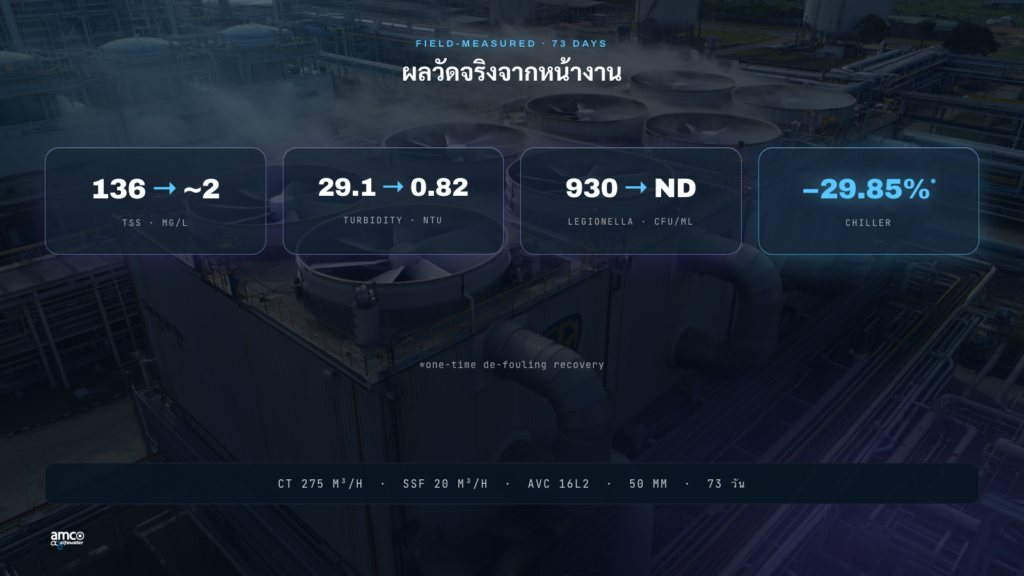
We ran an APEF + AVC bundle on a live cooling tower for 73 days (circulation 275 m³/h, a 20 m³/h side stream through an AVC 16L2 filter on a 50-micron screen) and logged the water throughout.
| Measure | Before | After | Tier |
|---|---|---|---|
| Legionella | 930 CFU/mL | Not detected | Measured |
| Suspended solids (TSS) | 136 mg/L | ~1–5 mg/L | Measured |
| Turbidity | 29.1 NTU | 0.82 NTU | Measured |
| Chemical dosing | baseline | −35% to −50% | Measured |
Two honesty notes matter more than the headline:
- This is habitat removal, not a field “kill.” Legionella fell to non-detect by pulling out the scale and biofilm it lived in, filtering the released organisms, and keeping a residual biocide — not by electrocuting or sterilising the water.
- Total bacteria were not “wiped out.” Overall counts stayed in the normal 10⁵–10⁶ CFU/mL band throughout, and a plant shutdown over Songkran caused a temporary post-shutdown spike. The confirmed, specific win is Legionella 930 → non-detect. We publish it that way because the honest result is strong enough on its own.
5. What this does not do
- It is not “chemical-free.” An open tower keeps a residual biocide; what changes is a large reduction in dosing (~35–50% measured), not zero chemicals.
- There is no “99.999% kill.” We don’t claim a log-kill figure. We remove the habitat and filter the released organisms.
- It is not a steriliser. Total bacteria stay in the normal band; the specific, measured result is on Legionella.
- It is not “zero maintenance.” It is dramatically less manual cleaning — never none.
If a Legionella claim sounds too clean to be true, we’ve probably chosen not to make it.
6. Is your tower at risk?
Risk rises with how scaled and how biofilm-lined your system already is, your water chemistry, and your operating temperatures — which is exactly why we don’t publish a single “you’ll be safe” number pinned to one site. The honest way to find your risk is to measure your tower: culture Legionella, check TSS and turbidity, and look at how much habitat is actually in the loop.
7. Frequently asked questions
Does side stream filtration kill Legionella?
Not by the field. It removes the scale and biofilm where Legionella lives, filters the released organisms, and works alongside a residual biocide. In our field trial, Legionella went from 930 CFU/mL to non-detect.
Is this chemical-free?
No — and we won’t claim it. An open cooling tower always keeps a residual biocide. Dosing dropped ~35–50% (measured).
Did it reduce all bacteria?
No. Total bacteria stayed in the normal 10⁵–10⁶ CFU/mL band. The specific measured win is Legionella to non-detect.
How fast does it work?
In our trial the clarity improved within weeks; note that in the first 2–4 weeks some readings can rise temporarily as old scale and biofilm break loose (that’s the descaling working), then drop.
Call to action
Book a free cooling-tower assessment. We’ll culture your water and measure your habitat load — sized to your tower, not a brochure average — before you commit to anything.
👉 amco.co.th/cooling-tower-assessment
📞 02-114-3085 · LINE: @amco · ✉ info@amco.co.th


