
Side stream filtration continuously cleans a small slipstream of your cooling-tower water — usually less than 10% of the recirculation flow — so the whole loop stays clear of the suspended solids, scale particles, and biofilm habitat that quietly raise your energy, water, and chemical bills. This guide explains what it does, how it actually works, and — just as importantly — what it does not do, backed by figures measured on a live cooling tower rather than a brochure.
Table of contents
- What is side stream filtration for a cooling tower?
- The four hidden costs of scale — one root cause
- How it works, honestly (the three-step mechanism)
- What a real field trial measured
- What side stream filtration does not do
- Side stream filtration vs. an old sand filter
- Is it right for your tower? (sizing, honestly)
- Frequently asked questions
1. What is side stream filtration for a cooling tower?
Side stream filtration means filtering a small, continuous slipstream of the recirculating water — typically under 10% of the total flow — and returning it clean to the loop. Because the same water passes through many times an hour, a small filter on a side loop keeps the entire system clean over the course of a day.
It matters because a cooling tower concentrates dirt. Every time water evaporates to reject heat, the calcium, minerals, and airborne dust left behind become more concentrated. Left alone, that load settles out as scale and biofilm on the hottest, most expensive surfaces in your plant — the heat-exchanger tubes. Side stream filtration is the mechanism that pulls that load back out of the water before it can settle.
2. The four hidden costs of scale — one root cause
A thin film of scale on a heat-exchange surface causes four separate costs at the same time:
- Energy. Scale is an insulator. A film as thin as 0.76 mm can cost a chiller roughly 27% of its efficiency — the compressor works harder to move the same heat, and you pay for it on every electricity bill.
- Water. To hold scale-forming minerals in check, operators dump concentrated water (blowdown) and top up with fresh — wasting water that evaporation didn’t take.
- Chemicals. Heavy antiscalant and biocide dosing is the usual defence against scale and the bacteria that grow in it.
- Bacteria. Old scale and biofilm are exactly where waterborne bacteria — including Legionella — make their home.
Here is the useful part: all four costs share a single root cause — scale sitting on the metal. Move that scale off the tubes and into the water, then filter it out, and you attack all four at once instead of chasing each with a separate chemical.
3. How it works, honestly (the three-step mechanism)
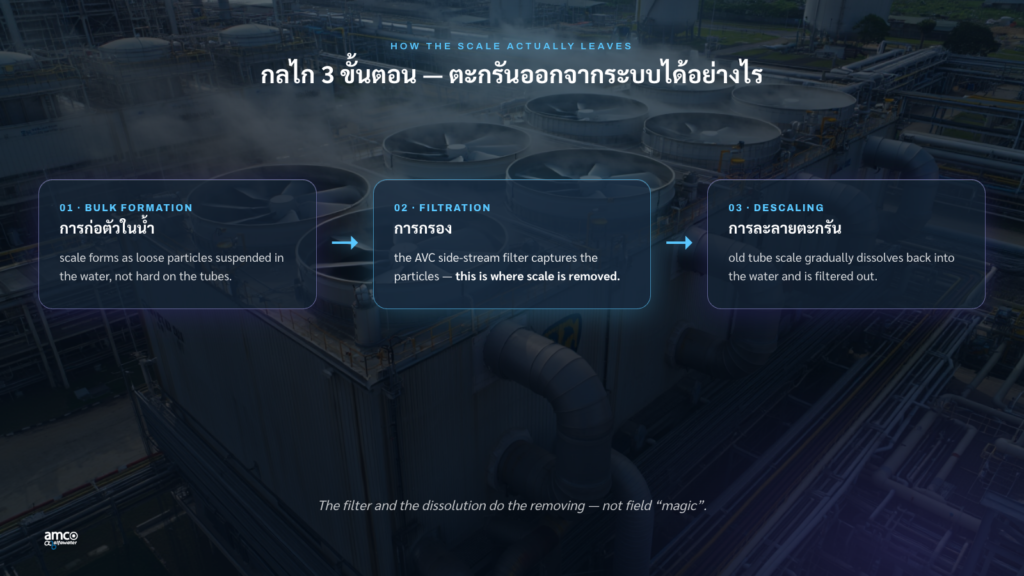
The AMCO approach pairs an Aragon APEF field with an AVC self-cleaning side-stream filter. Three things happen, in order:
- Bulk formation. The APEF field encourages calcium carbonate to form as tiny particles suspended in the flowing water rather than hardening onto the tube wall.
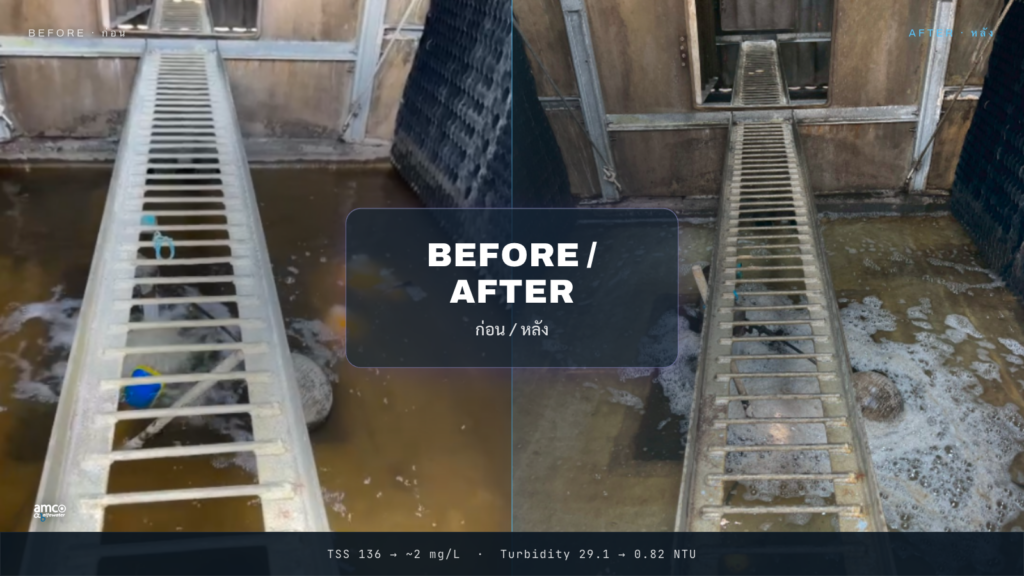
- Filtration. The AVC filter, on a small side loop, continuously captures those particles over many passes. This is where scale is actually removed from the system — and where you can literally see the captured solids.
- Descaling. As the circulating water carries less and less scale, older scale already bonded to the tubes gradually dissolves back into the water and is filtered out too. The biofilm habitat leaves with it.
The honest headline: the filter and the dissolution do the real work — not electric-field magic. Even the manufacturer sells the field and the filter as a bundle for exactly this reason. Any vendor who tells you a box on a pipe removes scale without a filter is selling you the half that doesn’t do the removing.
4. What a real field trial measured
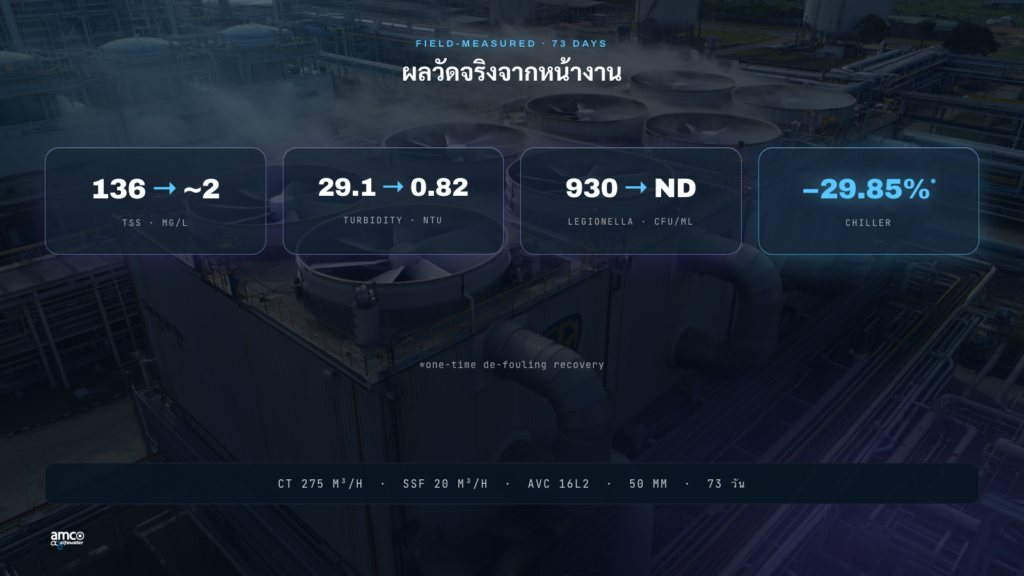
We ran an APEF + AVC bundle on a live cooling tower for 73 days and logged the water the whole way. The setup: circulation of 275 m³/h, a side-stream flow of 20 m³/h through an AVC 16L2 filter running a 50-micron screen.
The clearest, least arguable results are the water-clarity numbers — this is the filter doing visible work:
| Measure | Before | After | Tier |
|---|---|---|---|
| Suspended solids (TSS) | 136 mg/L | ~2 mg/L | Measured |
| Turbidity | 29.1 NTU | 0.82 NTU | Measured |
| Legionella | 930 CFU/mL | Not detected | Measured |
| Chiller efficiency | 0.776 kW/TonR | 0.544 kW/TonR | Measured (see note) |
| Make-up water | 24 m³/day | 20 m³/day | Measured |
| Chemical dosing | baseline | −35% to −50% | Measured |
Two honesty notes, because they matter more than the headline figures:
- The −29.85% chiller efficiency gain is a one-time recovery, not a permanent curve. It reflects a heavily fouled system being cleaned back toward its design point — a de-fouling recovery, not a number you keep improving on forever. On a well-maintained plant the recoverable penalty is far smaller (independent utility studies put it around 5–6%). The dirtier your system, the more there is to get back.
- Total bacteria fluctuated; they were not “wiped out.” Overall counts stayed in the normal 10⁵–10⁶ CFU/mL band throughout, and a plant shutdown over Songkran caused a temporary post-shutdown spike. The confirmed biological win is specific: Legionella fell from 930 CFU/mL to non-detect — achieved by removing the scale habitat and filtering, alongside a residual biocide, not by “killing” bacteria with the field.
That is the whole point of how we publish: the proven numbers are strong enough that we don’t need to borrow the ones that aren’t.
5. What side stream filtration does not do
This is the section most vendors skip, and it’s the reason skeptical engineers trust the rest:
- It is not “chemical-free.” An open cooling tower still needs a residual biocide. What you get is a large reduction in dosing (~35–50% measured), not zero chemicals.
- It does not “zap” or “sterilise” bacteria. There is no 99.999% kill. It removes the scale where bacteria live and filters the released organisms out.
- It is not “zero maintenance.” It is dramatically less manual cleaning — never none.
- It does not scrub or sandblast your tubes. Old scale is gently dissolved and filtered, not abraded. In a filtered loop, particle levels sit far below anything that has ever eroded a tube.
If a claim sounds too clean to be true, we’ve probably chosen not to make it.
6. Side stream filtration vs. an old sand filter
If you already run a slipstream through a sand or multimedia filter, the side-stream concept is familiar — but the filter is usually the weak link. A self-cleaning side-stream filter is finer (10–100 µm versus a coarse sand bed), cleans itself without taking the loop offline, uses far less backwash water, and has no media to dig out and replace every few years. We cover that head-to-head in detail in our sand-filter comparison — see เปลี่ยน Sand Filter มาเป็น Alfawater and the ARAGON APEF and amco Alfawater pages.
7. Is it right for your tower? (sizing, honestly)
Side stream filtration is sized to your recirculation rate, your water chemistry, and how fouled your system already is — which is exactly why we don’t publish a single “you’ll save X%” number pinned to one site. A heavily scaled chiller has a large penalty to recover; a well-run plant has a smaller one. Cycles of concentration can usually be raised toward the next real limit in your water, cutting blowdown — but that limit is site-specific, and we size it conservatively rather than promising a headline figure.
The honest way to find your number is to measure your tower, not to read a brochure average.
8. Frequently asked questions
What is side stream filtration? Filtering a small, continuous slipstream of the recirculating water — typically under 10% of the flow — so the whole loop stays clean.
How does side stream filtration work in a cooling tower? Scale is encouraged to form as suspended particles in the water instead of hard on the tubes; a side-stream filter captures those particles over many passes; and old scale on the tubes gradually dissolves back into the water and is filtered out too.
Can I replace my sand filter with a side stream filter? Yes. A self-cleaning side-stream filter is finer (10–100 µm), cleans without taking the loop offline, uses less backwash water, and needs no media replacement.
Does it kill Legionella? It doesn’t “kill” via the field. It removes the scale and biofilm where Legionella lives, filters the released organisms, and works alongside a residual biocide. In our field trial, Legionella went from 930 CFU/mL to non-detect.
Is this chemical-free? No — and we won’t claim it. It reduces chemical dosing (~35–50% measured); an open tower always keeps a residual biocide.
How much will it save on my tower? It depends on your tower’s size, water chemistry, and how fouled it is. The only honest answer is a measured one — book a free assessment and we’ll model it.
Call to action
Book a free cooling-tower assessment. We’ll measure your water and model your energy, water, and chemical savings — sized to your tower, not a brochure average — before you commit to anything.
👉 amco.co.th/cooling-tower-assessment 📞 02-114-3085 · LINE: @amco · ✉ info@amco.co.th Or DM us your tower’s tonnage and we’ll ballpark the savings.
Latest Posts
- Does Non-Chemical Cooling Tower Treatment Actually Work? An Honest Answer
- Cooling Tower Biofilm: The Hidden Threat Behind Scale, Bugs, and Bills
- Side Stream Filtration for Cooling Towers: 4 Hidden Costs It Cuts (The Honest Guide)
- Slip Hazard Checklist: 7 Factory Zones Every Safety Officer Must Inspect Before an Audit
- Anti-Slip for Steel Grating: 3 Permanent Fixes for Dangerously Slick Metal Walkways
Most Viewed Posts
- Transform Your Slippery Bathroom: 5 DIY Anti-Slip Solutions for Senior Safety.
- What to Do About Slippery Tile Floors? The Ultimate Guide to Solving the Problem, from Simple Fixes to Permanent Solutions
- Sand Filter vs. amco Alfawater: The Filtration Upgrade That Never Stops Your Line
- 3 Critical Reasons ‘Anti-Slip Tape’ Is a Hazard on Factory Floors (And the Ultimate Sustainable Solution).
- 5 Surprising Ways This New Tech “APEF” Uses Physics to Revolutionize Water Treatment
Alfawater amco Alfawater amco ANTI SLIP amco ANTI SLIP amco NOW ANTI BAC Anti Bac Anti Limescale APEF cooling tower DIY Glow Glow Industrial Industrial Water Treatment Sand Filter Scaling Side Stream Filtration กระเบื้อง กันลื่น ความปลอดภัยในบ้าน ฉุกเฉิน ทางหนีไฟ เครื่องกรองน้ำอุตสาหกรรม เรืองแสง โรงงานอุตสาหกรรม


