

A slip hazard checklist is the document that proves a safety officer (จป.) looked, found, and fixed — the difference between negligence and diligence when an inspector or auditor arrives. Under Thailand’s OSH Act B.E. 2554, a slippery floor is an unsafe condition and the duty to fix it sits with the employer. Seven zones account for most of the risk: stair nosings, walkways and ramps, steel floors and grating, wet and washdown areas, ladder rungs and access platforms, loading docks, and anti-slip that has already degraded. Walk them in that order, photograph what you find, and record the fix.
Table of Contents
- What is a slip hazard checklist, and why does a จป. need one?
- Why a slip hazard checklist is a legal document, not a formality
- The 7 zones at a glance
- Zone by zone: what to look for and what to fix
- How to record findings so they stand up in an audit
- From checklist to fix: what “addressed” actually means
- FAQ
1. What is a slip hazard checklist, and why does a จป. need one?
A slip hazard checklist is a structured walk-through of the places in a plant where people slip, with a recorded observation and a decided action for each one. It exists because slip risk is not distributed evenly across a factory — it concentrates in a small number of predictable zones, and those zones can be inspected in an afternoon.
It also exists because memory isn’t evidence. When something goes wrong, the question is never “did anyone notice?” — it’s “what did you do when you noticed?” A dated line in a checklist, with a photo and an action, answers that question. An undocumented walk-through does not.
The scale is real. In 2568 (2025), Thailand’s Workmen’s Compensation Fund (กองทุนเงินทดแทน, Social Security Office) recorded 12,855 incidents and 123 of 729 workplace deaths — about 1 in 6 — in the falls-and-slips category. That figure combines falls from height with same-level slips; what the two share is a foot losing grip on a surface an employer is required to keep safe. Manufacturing alone accounted for 41,767 injured workers — 46% of all workplace injuries that year.
2. Why a slip hazard checklist is a legal document, not a formality
Three sections of the Occupational Safety, Health and Environment Act B.E. 2554 (2011) decide who carries the risk:
- §6 — the employer must arrange and maintain the workplace so that conditions are safe. A slippery floor is, by definition, not a safe condition.
- §7 — the cost of meeting that duty is the employer’s. “It wasn’t budgeted” is not a defence.
- §8 — the employer must comply with the ministerial standards. Failing to do so can mean up to 1 year’s imprisonment, a fine of up to ฿400,000, or both; across the Act the maximum reaches 2 years and ฿800,000.
These are criminal, not administrative, consequences. Which is why a completed slip hazard checklist, filed and dated, is worth more than a clean-looking floor. (The full breakdown of the three sections is in our anti-slip law guide.)
3. The 7 zones at a glance
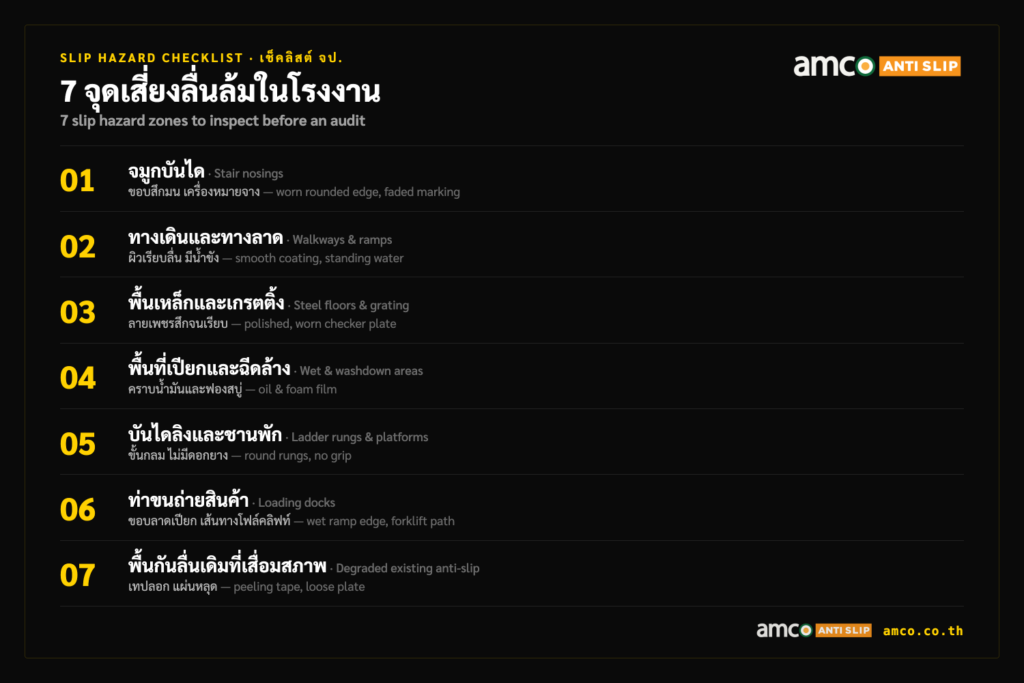
Print this table and walk it in order — highest-consequence zones first.
| # | Zone | The failure you’re looking for | The permanent fix |
|---|---|---|---|
| 1 | Stair nosings | Worn, rounded or shiny step edges; peeling tape | Engineered stair nosing, mechanically fixed |
| 2 | Walkways & ramps | Wet, oily or polished surface; slope with no grip | Bonded anti-slip plate, tested wet |
| 3 | Steel floors & grating | Polished checker plate; oil film; mirror-bright bar edges | Engineered plate or custom-cut panel |
| 4 | Wet & washdown areas | Standing water, grease, foam; smooth floor | Wet-rated grip (R11 / PTV 36+ wet) + sealed edges |
| 5 | Ladder rungs & platforms | Smooth or worn rungs; grip only on the centre | Anti-slip rung covers |
| 6 | Loading docks & vehicle interfaces | Rain-wet edges; diesel and hydraulic spill; step-downs | Grip plate + fused warning stripes |
| 7 | Degraded existing anti-slip | Curled tape, lost grit, lifted edges | Replace with a surface that doesn’t need replacing |
4. Zone by zone: what to look for and what to fix
Zone 1 — Stair nosings
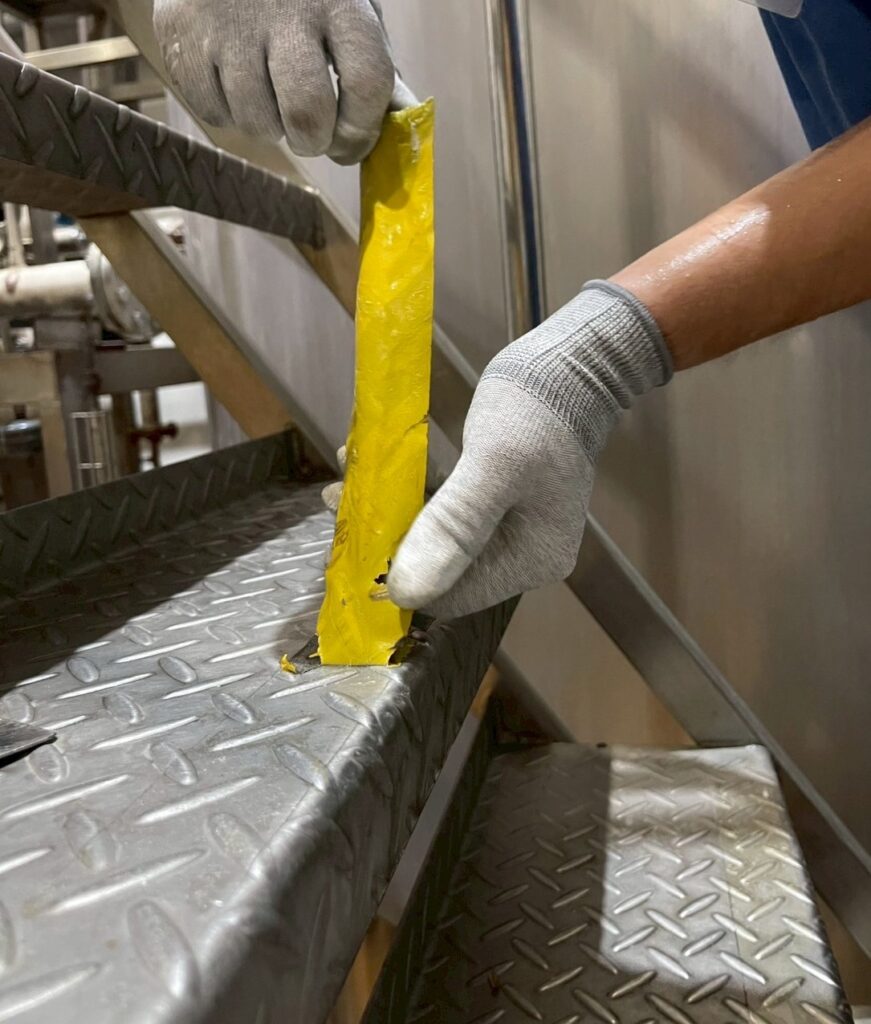
The single highest-consequence zone. The step edge takes the most load per square centimetre and wears fastest, and a slip there becomes a fall down the flight rather than a stumble on the flat. Look for: rounded or polished nose edges, tape that has curled at the corner, missing grip on the outer third of the tread where people actually walk. Fix: an engineered nosing, mechanically fixed. See the stair nosing guide.
Zone 2 — Walkways and ramps
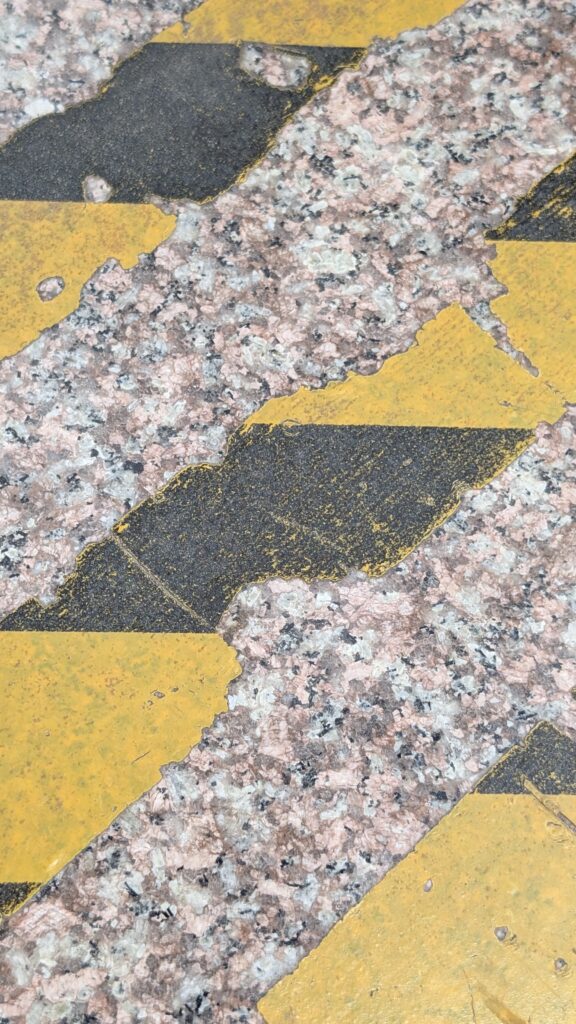
Look for: any surface that carries a film — water tracked from a washdown, oil migrating from a machine, condensation under a chilled line. Ramps compound it: a slope needs more grip than a flat floor to be equally safe. Fix: a surface with a tested wet figure. Dry grip is easy; wet is where people fall.
Zone 3 — Steel floors and grating
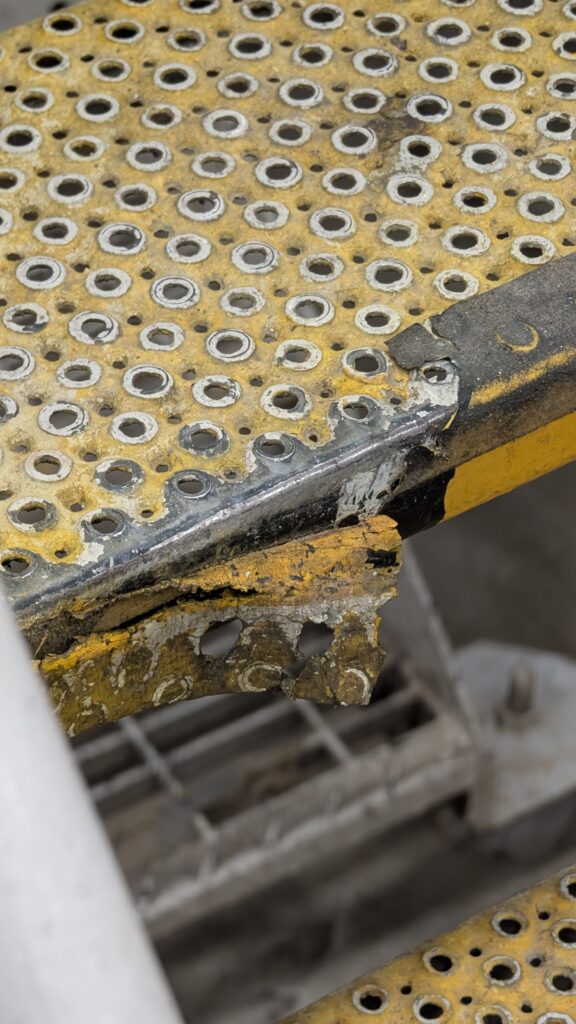
Look for: checker-plate diamonds that have gone shiny and flat, grating bars with a mirror-polished top edge, and any tape lifting off metal. Fix: engineered plate for solid steel, custom-cut panels for grating so drainage stays open. Details in the steel and grating guide.
Zone 4 — Wet and washdown areas
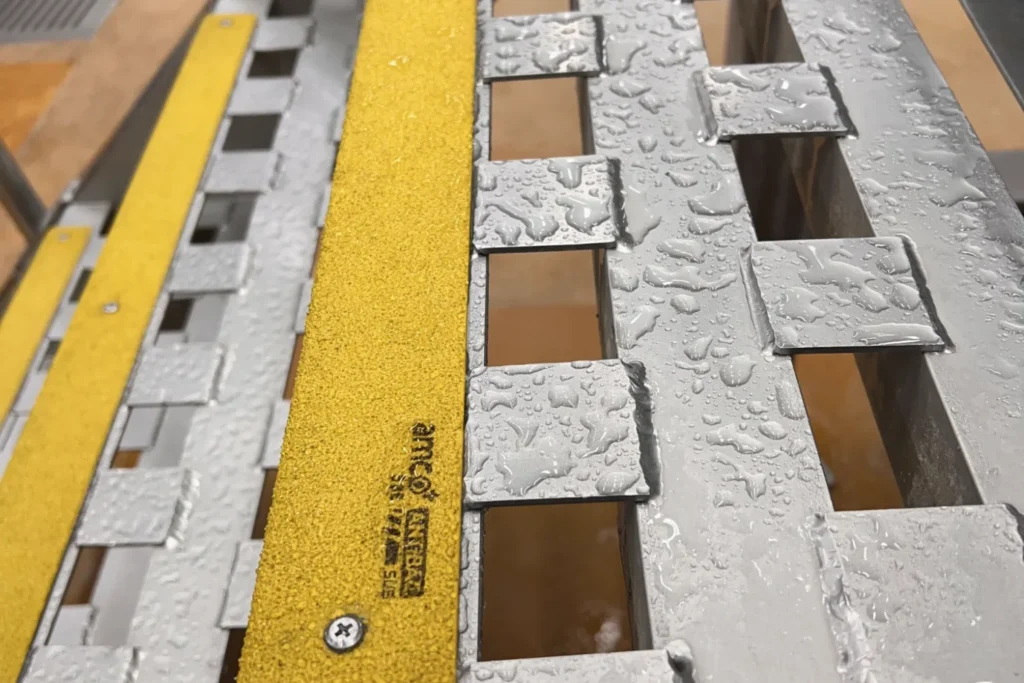
Look for: standing water after cleaning, grease and foam residue, and — in food and pharma — open edges under any grip product where debris and bacteria collect. Fix: a wet-rated grip surface with food-grade sealed edges and food-grade SS304 fixings. See the food factory requirements.
Zone 5 — Ladder rungs and access platforms
Look for: rungs worn smooth in the middle, oil transfer from gloves and boots, platforms where the deck is fine but the transition step isn’t. This zone is where a slip becomes a fall from height. Fix: anti-slip rung covers and platform plate.
Zone 6 — Loading docks and vehicle interfaces
Look for: dock edges exposed to rain, diesel and hydraulic fluid drips, and the step-down between dock and trailer bed where footing changes without warning. Fix: grip plate with fused warning stripes — the marking is part of the plate, so it never peels off like a painted line or a sticker.
Zone 7 — Anti-slip that has already degraded
The zone people forget, because it’s already been “fixed.” Look for: anti-slip tape that has curled, lost its grit, or peeled entirely. A lifted strip is worse than bare floor — it’s a trip hazard sitting on top of a slip hazard. Fix: stop re-buying the failure. Tape lasts roughly two months on a busy stair; over five years that’s 30+ re-installs, each with a window of exposed, unprotected surface in between. The 5-year cost comparison has the full math.
5. How to record findings so they stand up in an audit
The checklist is only as good as the record behind it. Four things, every time:
- Date and name. Who inspected, when. An undated observation is not evidence.
- A photograph of the actual hazard. One photo of the worn nosing beats a paragraph describing it.
- The decided action, with an owner and a date. “Replace nosing on Stair B — Somchai — 15 Aug” closes the loop that “monitor” leaves open.
- The test data for whatever you install. A pendulum PTV figure measured wet, or a shod ramp R-value, from a named method (BS 7976-2, DIN EN 16165). A marketing claim isn’t a measurement. Our slip ratings guide explains how to read a test report.
Keep the test report, the install record and the maintenance schedule together. That folder is what demonstrates the §6 duty was met.
6. From checklist to fix: what “addressed” actually means
A hazard is addressed when it stops recurring — not when it’s been covered over. This is the distinction auditors probe, and it’s where a slip hazard checklist repeated year after year exposes the truth: if the same stair edge appears on every checklist, the fix isn’t working.
That’s the case for engineering the surface rather than taping it. A silicon-carbide grip surface (Mohs ~9.5, one grade below diamond) bonded into a multi-layer plate holds its grip through years of boots instead of wearing smooth — tested at PTV 70 dry / 65 wet against a ≥36 safe minimum, shod ramp R11, with a 5+ year service life and a 2-year warranty. amco’s engineered anti-slip is installed across 145 projects, 95 organizations and 15 industries, with 7,390 documented install photos — the record an auditor can actually inspect.
Walk the seven zones. Photograph what you find. Fix it once.
FAQ
Q1: What should a slip hazard checklist include? Seven zones — stair nosings, walkways and ramps, steel floors and grating, wet and washdown areas, ladder rungs and platforms, loading docks, and degraded existing anti-slip — with a dated observation, a photograph, and a decided action with an owner for each.
Q2: Who is responsible for slip hazards in a Thai factory? The employer. Under the OSH Act B.E. 2554, §6 requires safe working conditions and §7 places the cost of safety measures on the employer, not the worker.
Q3: How often should a safety officer run a slip hazard checklist? There’s no single mandated interval, so match it to the risk: high-traffic wet zones warrant a monthly walk, the full seven-zone inspection at least quarterly, and always after a change to the process, the cleaning regime, or the floor itself.
Q4: Which zone should be inspected first? Stair nosings. The step edge wears fastest, carries the highest load per square centimetre, and a slip there becomes a fall down the flight rather than a stumble.
Q5: How do I prove a floor is safe? With measured data, not a claim: a pendulum PTV figure taken in the wet condition (36+ = low slip potential, method BS 7976-2) or a shod ramp R-value (DIN EN 16165). Keep the test report with the install record.
Q6: Is anti-slip tape enough to close a checklist item? Rarely. Tape degrades in roughly two months, so the same hazard reappears before the next inspection. A tested, durable engineered surface with documented performance is far easier to defend as having addressed the hazard.
Contact: 📞 02-114-3085 · LINE: @amco ·
🌐 amco.co.th · ✉ info@amco.co.th Free consultation & site survey available.
Law → https://amco.co.th/anti-slip-law-thailand/
Slip ratings → https://amco.co.th/slip-resistance-rating-explained/
Stair nosing → https://amco.co.th/anti-slip-stair-nosing/
5-year cost → https://amco.co.th/anti-slip-cost-5-year/
Food factory → https://amco.co.th/food-factory-anti-slip-flooring/
Choose material → https://amco.co.th/how-to-choose-anti-slip-material/
Steel & grating → https://amco.co.th/anti-slip-for-steel-grating/
Latest Posts
- Does Non-Chemical Cooling Tower Treatment Actually Work? An Honest Answer
- Cooling Tower Biofilm: The Hidden Threat Behind Scale, Bugs, and Bills
- Side Stream Filtration for Cooling Towers: 4 Hidden Costs It Cuts (The Honest Guide)
- Slip Hazard Checklist: 7 Factory Zones Every Safety Officer Must Inspect Before an Audit
- Anti-Slip for Steel Grating: 3 Permanent Fixes for Dangerously Slick Metal Walkways
Most Viewed Posts
- Transform Your Slippery Bathroom: 5 DIY Anti-Slip Solutions for Senior Safety.
- What to Do About Slippery Tile Floors? The Ultimate Guide to Solving the Problem, from Simple Fixes to Permanent Solutions
- Sand Filter vs. amco Alfawater: The Filtration Upgrade That Never Stops Your Line
- 3 Critical Reasons ‘Anti-Slip Tape’ Is a Hazard on Factory Floors (And the Ultimate Sustainable Solution).
- 5 Surprising Ways This New Tech “APEF” Uses Physics to Revolutionize Water Treatment
Alfawater amco Alfawater amco ANTI SLIP amco ANTI SLIP amco NOW ANTI BAC Anti Bac Anti Limescale APEF cooling tower DIY Glow Glow Industrial Industrial Water Treatment Sand Filter Scaling Side Stream Filtration กระเบื้อง กันลื่น ความปลอดภัยในบ้าน ฉุกเฉิน ทางหนีไฟ เครื่องกรองน้ำอุตสาหกรรม เรืองแสง โรงงานอุตสาหกรรม


