
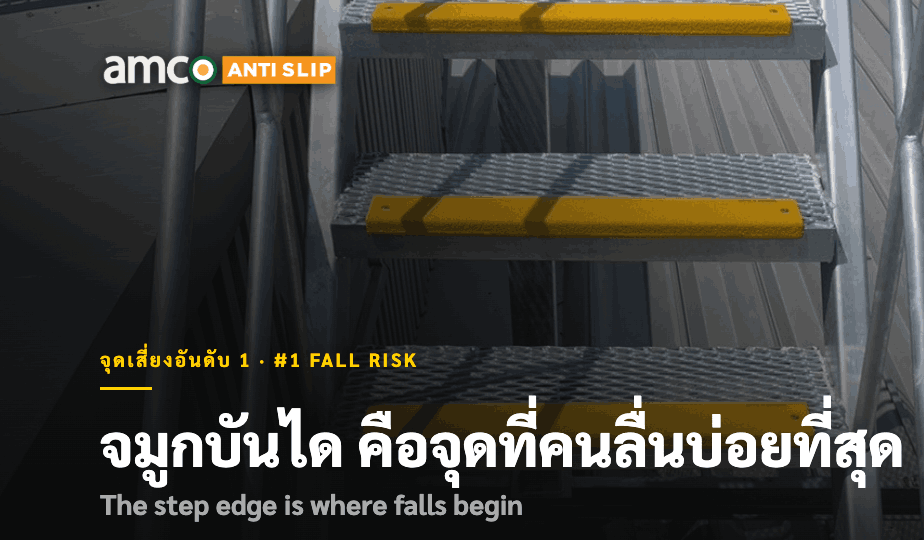
The edge of a step — the stair nosing — is where the largest share of workplace falls begins, because that’s where a foot meets the smallest, most worn contact patch. Good anti-slip stair nosing fixes it permanently, but only if you choose the right one. The five things that matter: the material (food-grade stainless vs aluminium vs zinc-plated), a real slip rating (R11 / PTV), the right thickness, a glow option for escape routes, and fixings that seal the edge. Tape fails here fastest of all — the step edge is the highest-wear point in the building.
Table of Contents
- Why is the stair nosing the #1 slip-and-fall risk?
- What is anti-slip stair nosing (and how is it different from tape)?
- Why does anti-slip tape fail on stair edges first?
- How to choose anti-slip stair nosing: 5 checks
- Install once, or replace 30+ times?
- Where anti-slip stair nosing matters most
- FAQ
1. Why is the stair nosing the #1 slip-and-fall risk?
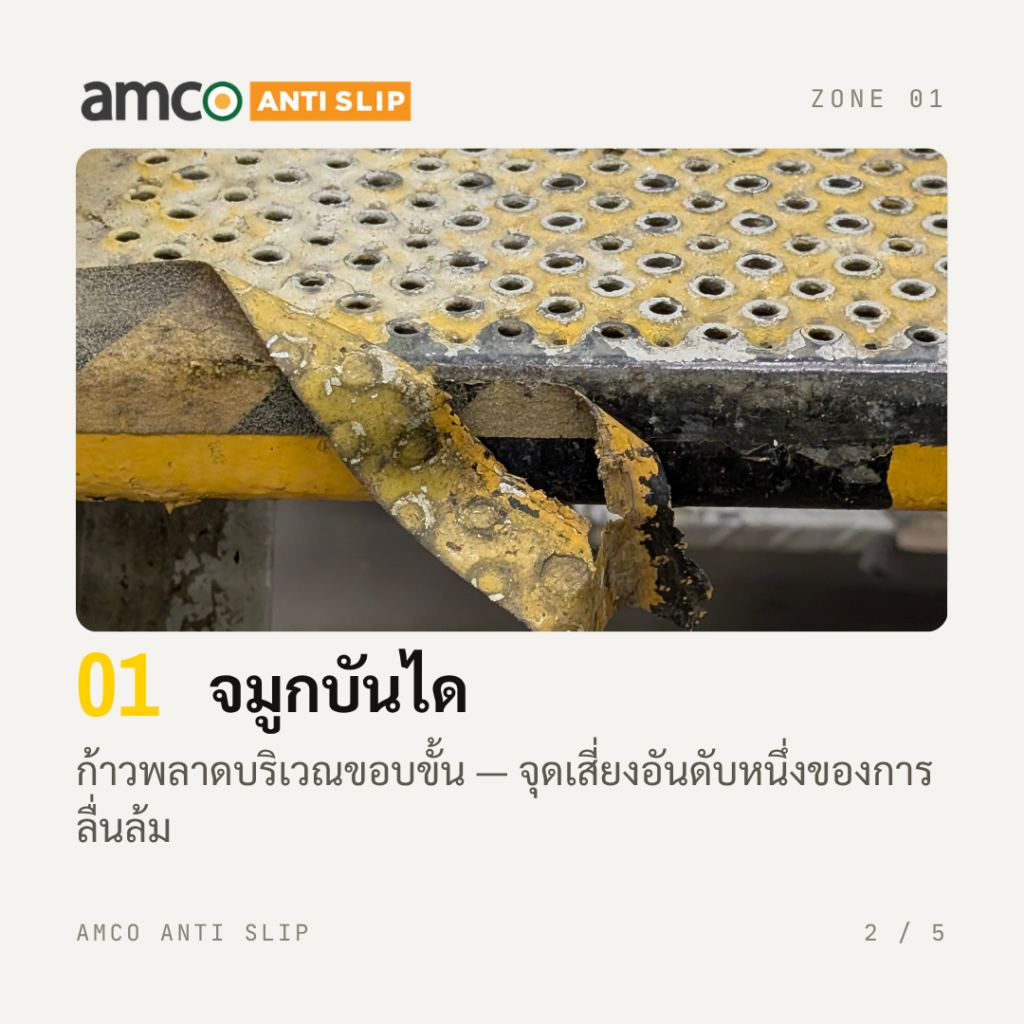
The stair nosing is the front edge of each step — the exact point a foot lands on and pushes off from. It’s the highest-risk spot on any staircase for three reasons: it takes the most foot traffic per square centimetre, it’s where momentum is greatest (a slip here becomes a fall down the flight, not a stumble on the flat), and it wears faster than any other surface in the building. That combination is why stair edges account for such a large share of slip-and-fall injuries in industrial settings — and why they’re the first place a safety officer should look.
Fix the nosing and you remove the single most dangerous point on the stairs. That’s what anti-slip stair nosing is designed to do.
2. What is anti-slip stair nosing (and how is it different from tape)?
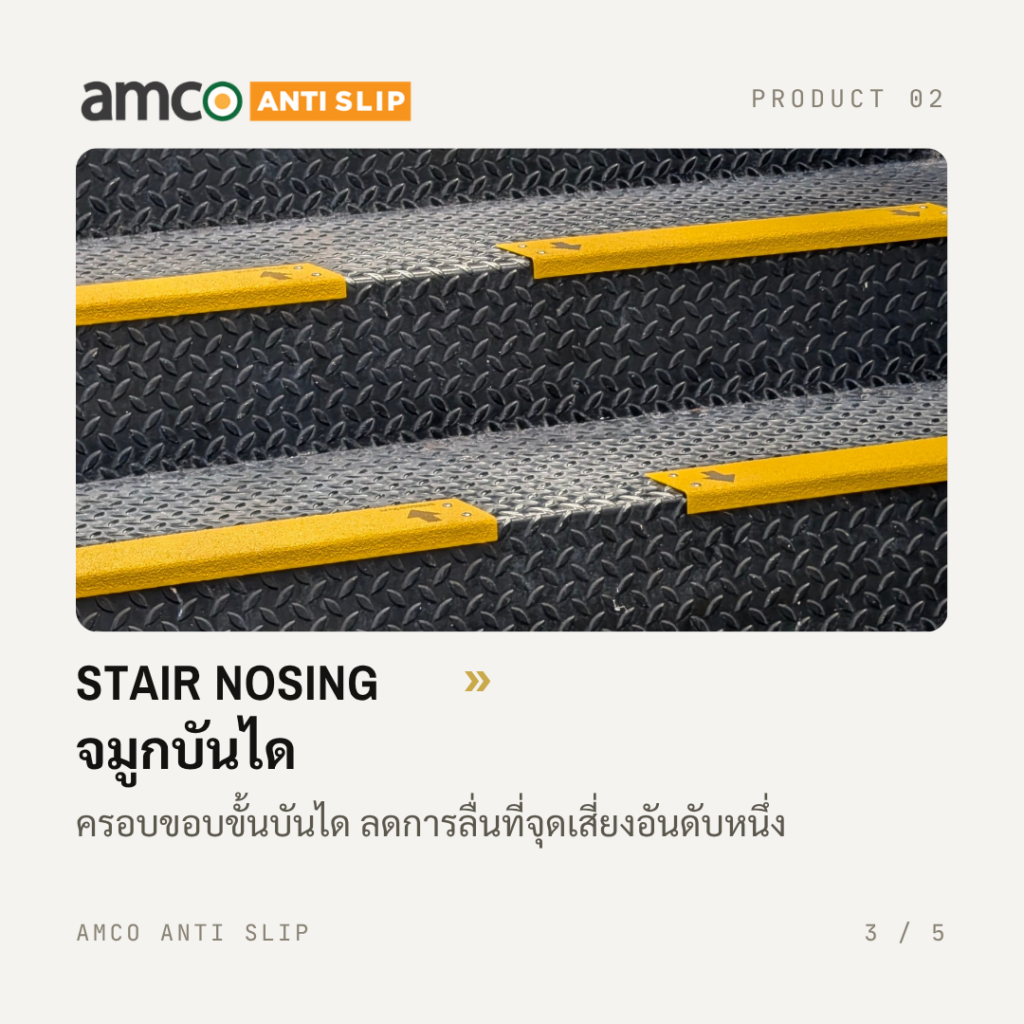
Anti-slip stair nosing is an engineered plate fitted along the front edge of a step to give a durable, high-grip surface exactly where feet land. Unlike anti-slip tape — a thin abrasive layer stuck on with adhesive — an engineered nosing is a solid multi-layer plate: a hard grip surface bonded into a metal core, mechanically fixed to the step. It doesn’t rely on glue to stay down, and it doesn’t wear smooth after a few weeks.
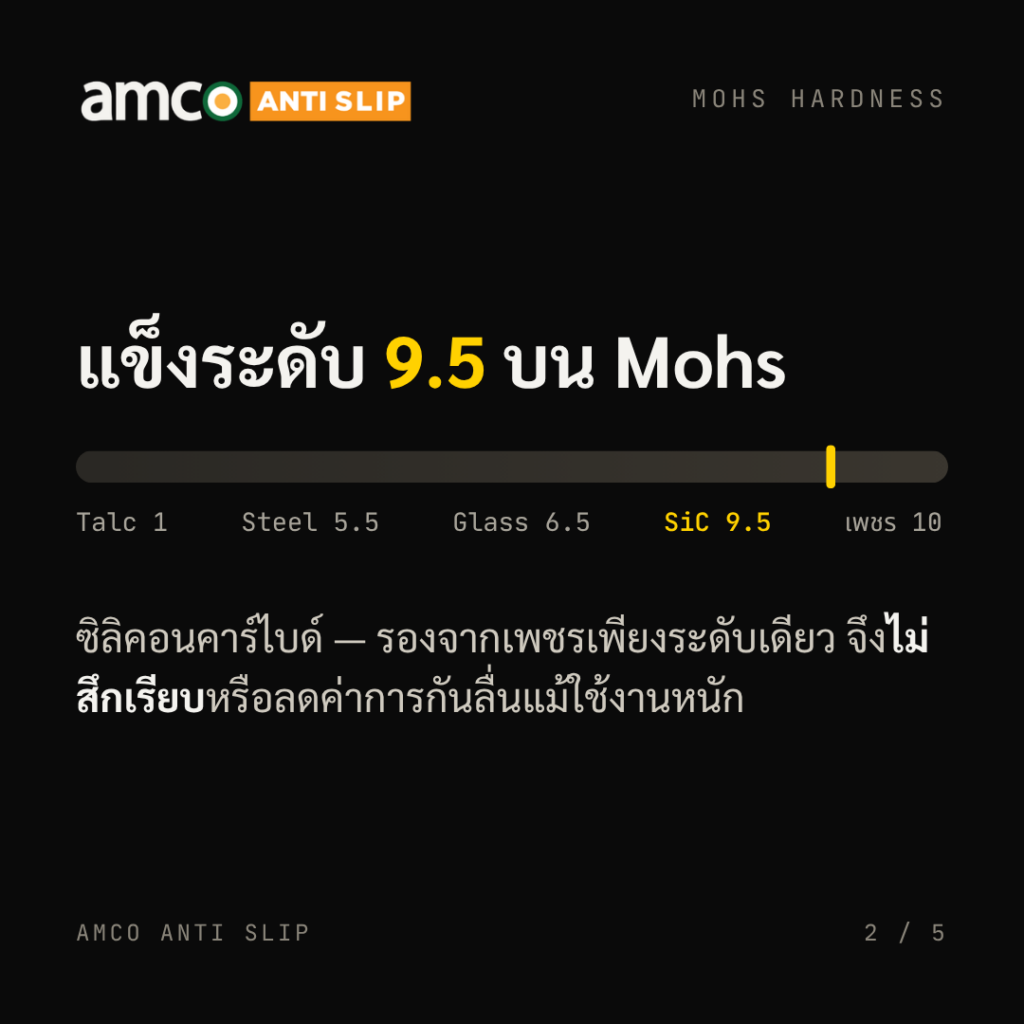
The practical difference is lifespan and grip retention. amco’s nosing is built on a silicon-carbide grip surface (Mohs ~9.5) — one of the hardest materials there is — fused into the plate rather than sprinkled on top, so it keeps its grip through years of boots instead of polishing flat.
| Anti-slip tape | Engineered anti-slip stair nosing | |
|---|---|---|
| Construction | Thin abrasive + adhesive | Multi-layer plate, mechanically fixed |
| Grip source | Coating that wears | Silicon carbide bonded in (Mohs ~9.5) |
| Edge behaviour | Peels and curls | Sealed, stays put |
| Service life | ~2 months | 5+ years |
| Re-installs / 5 yrs | 30+ | 1 |
3. Why does anti-slip tape fail on stair edges first?
Because the step edge is the worst possible place for an adhesive product. The nosing bends around a 90° corner, so the tape is under constant peel stress; every footstrike hits the leading edge; and water, oil or cleaning fluid works under the lifted corner. The result is the familiar sight in older factories: tape that has curled up at the nose, lost its grit, or peeled away entirely — which is not just ineffective but a trip hazard in its own right. A “fix” that fails becomes a new risk, and on stairs that risk is a fall.
4. How to choose anti-slip stair nosing: 5 checks
Not all nosings are equal. These five checks separate a lasting solution from another short-term patch:
- 1. Material. Match it to the environment. Stainless steel 304/316 is food-grade and corrosion-resistant (essential for food, pharma, washdown areas); aluminium is light for lower-load walkways; zinc-plated steel suits general industrial use. The wrong material corrodes or fails early.
- 2. Slip rating. Ask for a real, tested figure — not a claim. Look for pendulum PTV and shod ramp R11 or higher. amco tests at PTV 70 dry / 65 wet (roughly double the ≥36 safe minimum) and R11. (For how to read these, see our slip-ratings guide.)
- 3. Thickness and profile. Too thin and it wears through; too thick and the nosing itself becomes a trip lip. amco plates start from 1.7 mm (up to 5 mm for the heaviest grades), engineered to grip without creating a new edge to catch.
- 4. Glow option for escape routes. On fire-escape and emergency stairs, a photoluminescent (glow) nosing stays visible in the dark — amco GLOW illuminates for up to 6 hours after the lights go out, marking the step edge when it matters most.
- 5. Fixings and edge sealing. For hygienic areas, food-grade SS304 fixings and sealed edges stop water, food debris and bacteria collecting under the plate. This is what turns “a grippy strip” into a properly installed, auditable system.
5. Install once, or replace 30+ times?
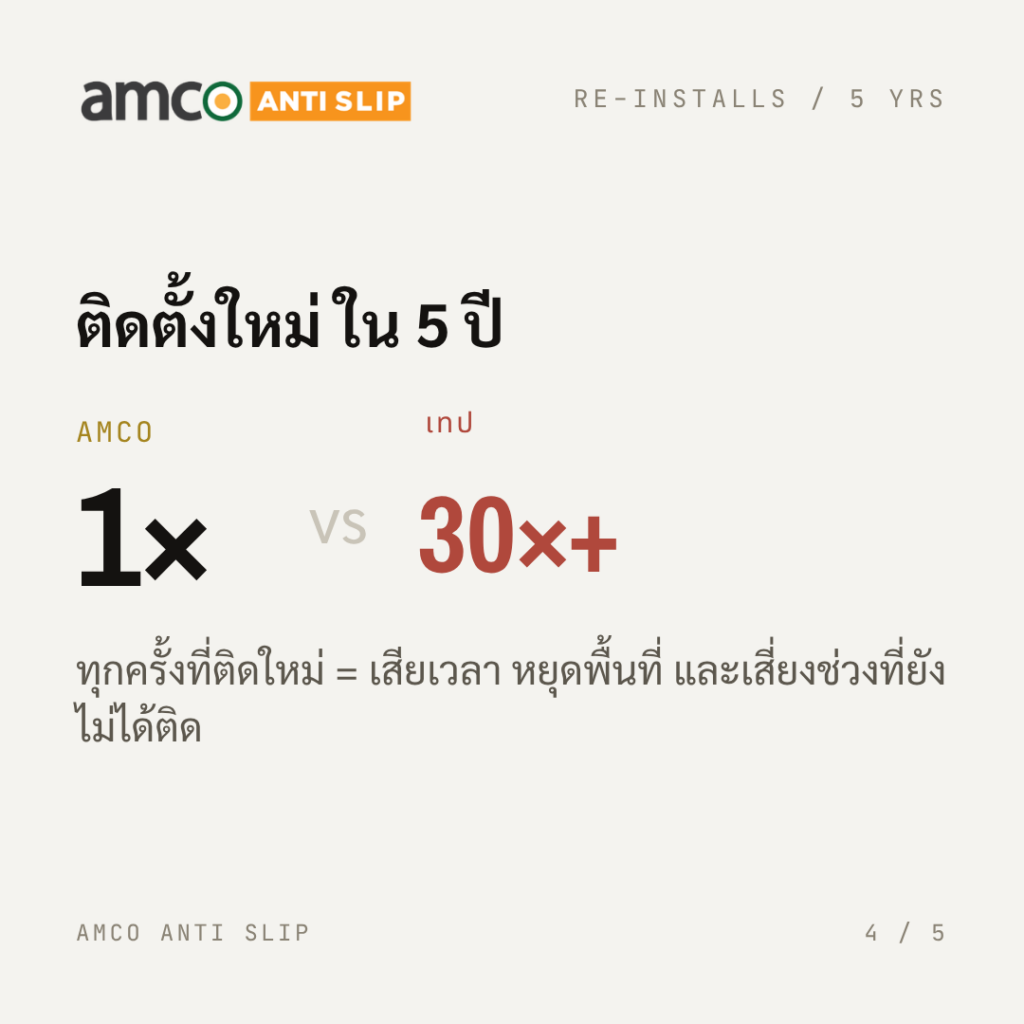
This is the real cost question. Anti-slip tape lasts roughly two months on a busy stair, so over five years you’re re-doing the same edges 30+ times — each time paying for material, labour and the downtime of closing the stairs. An engineered nosing is installed once and carries a 5+ year service life with a 2-year warranty. It costs more on day one and far less over the life of the stairs — and it doesn’t leave gaps of exposed, worn edge between re-applications when someone could slip.
6. Where anti-slip stair nosing matters most
Anywhere people carry loads up and down steps in wet, oily or high-traffic conditions: food and beverage plants (washdown stairs, freezer areas), manufacturing and warehousing (mezzanines, loading platforms), petrochemical and heavy industry (offshore-grade grip), and transport and public facilities (high footfall). amco’s engineered nosing is installed across 145 projects in 15 industries — the same edges, made safe and kept safe.
FAQ
Q1: What is anti-slip stair nosing? It’s an engineered plate fitted along the front edge of a step to provide durable, high-grip footing exactly where people step. Unlike anti-slip tape, it’s a mechanically fixed multi-layer plate that doesn’t peel or wear smooth.
Q2: Why is anti-slip tape a bad idea on stairs? The step edge bends around a corner and takes every footstrike, so tape peels and curls quickly — often within weeks — and a lifted, worn strip becomes a trip hazard itself.
Q3: What slip rating should stair nosing have? Ask for tested figures. A pendulum PTV of 36+ (wet) is the safe benchmark and R11 is a solid shod-ramp rating for industrial stairs. amco tests at PTV 70/65 and R11.
Q4: Can stair nosing glow in the dark for fire escapes? Yes. Photoluminescent (glow) nosing marks the step edge in darkness — amco GLOW stays visible for up to 6 hours, useful on emergency and fire-escape stairs.
Q5: How long does engineered stair nosing last vs tape? Anti-slip tape lasts around 2 months on busy stairs; an engineered nosing has a 5+ year service life (2-year warranty), so it’s installed once instead of 30+ times over five years.
สถิติกองทุนเงินทดแทน (การลื่นล้ม/ตก)
Contact block: 📞 02-114-3085 · LINE: @amco ·
🌐 amco.co.th · ✉ info@amco.co.th Free consultation & site survey available.
Latest Posts
- Does Non-Chemical Cooling Tower Treatment Actually Work? An Honest Answer
- Cooling Tower Biofilm: The Hidden Threat Behind Scale, Bugs, and Bills
- Side Stream Filtration for Cooling Towers: 4 Hidden Costs It Cuts (The Honest Guide)
- Slip Hazard Checklist: 7 Factory Zones Every Safety Officer Must Inspect Before an Audit
- Anti-Slip for Steel Grating: 3 Permanent Fixes for Dangerously Slick Metal Walkways
Most Viewed Posts
- Transform Your Slippery Bathroom: 5 DIY Anti-Slip Solutions for Senior Safety.
- What to Do About Slippery Tile Floors? The Ultimate Guide to Solving the Problem, from Simple Fixes to Permanent Solutions
- Sand Filter vs. amco Alfawater: The Filtration Upgrade That Never Stops Your Line
- 3 Critical Reasons ‘Anti-Slip Tape’ Is a Hazard on Factory Floors (And the Ultimate Sustainable Solution).
- 5 Surprising Ways This New Tech “APEF” Uses Physics to Revolutionize Water Treatment
Alfawater amco Alfawater amco ANTI SLIP amco ANTI SLIP amco NOW ANTI BAC Anti Bac Anti Limescale APEF cooling tower DIY Glow Glow Industrial Industrial Water Treatment Sand Filter Scaling Side Stream Filtration กระเบื้อง กันลื่น ความปลอดภัยในบ้าน ฉุกเฉิน ทางหนีไฟ เครื่องกรองน้ำอุตสาหกรรม เรืองแสง โรงงานอุตสาหกรรม


