
Under Thailand’s Occupational Safety, Health and Environment Act B.E. 2554 (2011), a slippery walkway or stair is legally an “unsafe condition.” Three sections — §6, §7 and §8 — put the duty, the cost, and the penalty squarely on the employer, not the worker. Breaching the standards can mean imprisonment and fines up to ฿800,000. For a safety officer (จป.), fixing slip hazards isn’t optional housekeeping — it’s legal compliance.
Table of Contents
- Is a slippery floor really covered by anti-slip law in Thailand?
- What anti-slip law in Thailand actually says (OSH Act B.E. 2554)
- §6 — the employer must provide a safe workplace
- §7 — the employer pays for safety, not the worker
- §8 — breach the standard, face the penalty
- How big is the slip-and-fall problem, really?
- What a safety officer should actually do about slippery floors
- How engineered anti-slip surfaces meet the legal duty
- FAQ
1. Is a slippery floor really covered by anti-slip law in Thailand?
Yes. A wet, oily, or worn walkway is not just a housekeeping problem — under anti-slip law in Thailand it is an unsafe working condition, and the responsibility to fix it sits with the employer. The governing statute is the Occupational Safety, Health and Environment Act B.E. 2554 (2011), which requires employers to provide safe conditions, pay for that safety, and follow the ministerial standards — with real criminal penalties for failing to do so.
For a safety officer (จป.), that reframes a slippery stair from “we’ll get to it” into a documented compliance obligation. The three sections below are the ones you need to know.
2. What anti-slip law in Thailand actually says (OSH Act B.E. 2554)
Anti-slip law in Thailand isn’t a single “flooring” rule — it works at the level of principle. The Act (พ.ร.บ. ความปลอดภัย อาชีวอนามัย และสภาพแวดล้อมในการทำงาน พ.ศ. 2554) doesn’t name “anti-slip flooring” specifically; instead it makes the employer responsible for a safe working environment, and slippery surfaces are one of the clearest, most preventable hazards that fall under it. Three sections carry the weight for slip-and-fall risk.
3. §6 — the employer must provide a safe workplace
§6 (มาตรา 6) requires the employer to arrange and maintain the workplace, machinery, and working conditions so they are safe for employees. A floor that is slippery — from water, oil, or degraded grip — is by definition a condition that is not safe. That places it inside the employer’s §6 duty. In practice, this is what auditors and inspectors point to when a known slip hazard has been left unaddressed.
4. §7 — the employer pays for safety, not the worker
§7 (มาตรา 7) makes clear that the cost of carrying out safety duties under the Act is the employer’s to bear — it cannot be pushed onto the employee. So “the anti-slip fix is a budget problem” is not a legal defence; providing a safe surface is a cost the law assigns to the employer. This matters at procurement time: safety spending isn’t discretionary goodwill, it’s a statutory cost.
5. §8 — breach the standard, face the penalty
§8 (มาตรา 8) requires employers to comply with the standards set out in the ministerial regulations issued under the Act. Failing to meet those standards carries a penalty of imprisonment of up to 1 year, a fine of up to ฿400,000, or both. Across the Act, the maximum penalty reaches 2 years’ imprisonment and a fine of up to ฿800,000 for the more serious breaches. These are criminal, not merely administrative, consequences — a strong reason to treat known slip hazards as a priority, not a backlog item.
Quick reference: the three sections
| Section | What it requires | Who it lands on |
|---|---|---|
| §6 | Provide and maintain safe working conditions (a slippery floor = unsafe) | Employer |
| §7 | Bear the cost of meeting safety duties | Employer (not the worker) |
| §8 | Comply with ministerial safety standards | Employer — breach = up to 1 yr / ฿400,000 (Act ceiling 2 yr / ฿800,000) |
6. How big is the slip-and-fall problem, really?
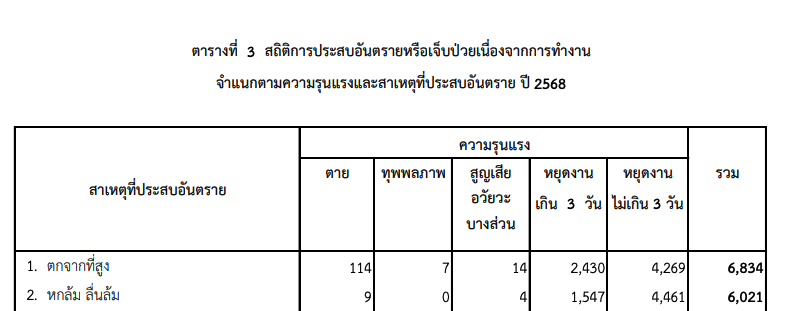
The legal duty exists because the human toll is real. In 2568 (2025), Thailand’s Workmen’s Compensation Fund (กองทุนเงินทดแทน, Social Security Office) recorded that 123 of 729 workplace deaths — about 1 in 6 — were caused by falls from height or slips. In the same category there were 12,855 recorded incidents nationwide.
Not every one of those 123 deaths is a same-level slip — the figure combines falls from height with same-level slips — but a large share begins the same way: a foot losing grip on a stair edge, a ladder rung, an oily walkway, or a wet steel floor. Those are exactly the surfaces the law expects an employer to keep safe, and exactly the surfaces an engineered anti-slip system is built for.
7. What a safety officer should actually do about slippery floors
You don’t need to quote statute numbers to management — you need a defensible process. Practical steps:
- Map the risk zones. Stair nosings, ramps, wet or oily walkways, steel floors and grating, ladder rungs. These are where slips concentrate.
- Document the hazard. A photo and a note turn “we knew” into “we acted” — the difference between negligence and diligence in an audit.
- Specify a tested solution, not a temporary one. Anti-slip tape degrades in weeks; a surface that fails again is a hazard that reappears. Choose something with documented slip-resistance test data.
- Keep the paper trail. Test reports, install records, and a maintenance schedule are your evidence that the §6 duty was met.
8. How engineered anti-slip surfaces meet the legal duty
Meeting the §6 duty means the fix has to stay safe, not just look safe on install day. AMCO’s engineered anti-slip is built on a silicon-carbide grip surface (Mohs ~9.5) bonded into a multi-layer plate — it doesn’t peel or delaminate like tape, and it holds its grip through heavy traffic. It’s tested to international slip standards (pendulum PTV 70 dry / 65 wet, roughly double the ≥36 safe minimum; ramp R11 shod; Class C barefoot), with a documented 5+ year service life and a 2-year warranty. That combination — tested performance plus a durable surface plus records — is what lets a safety officer show a known hazard was addressed properly.
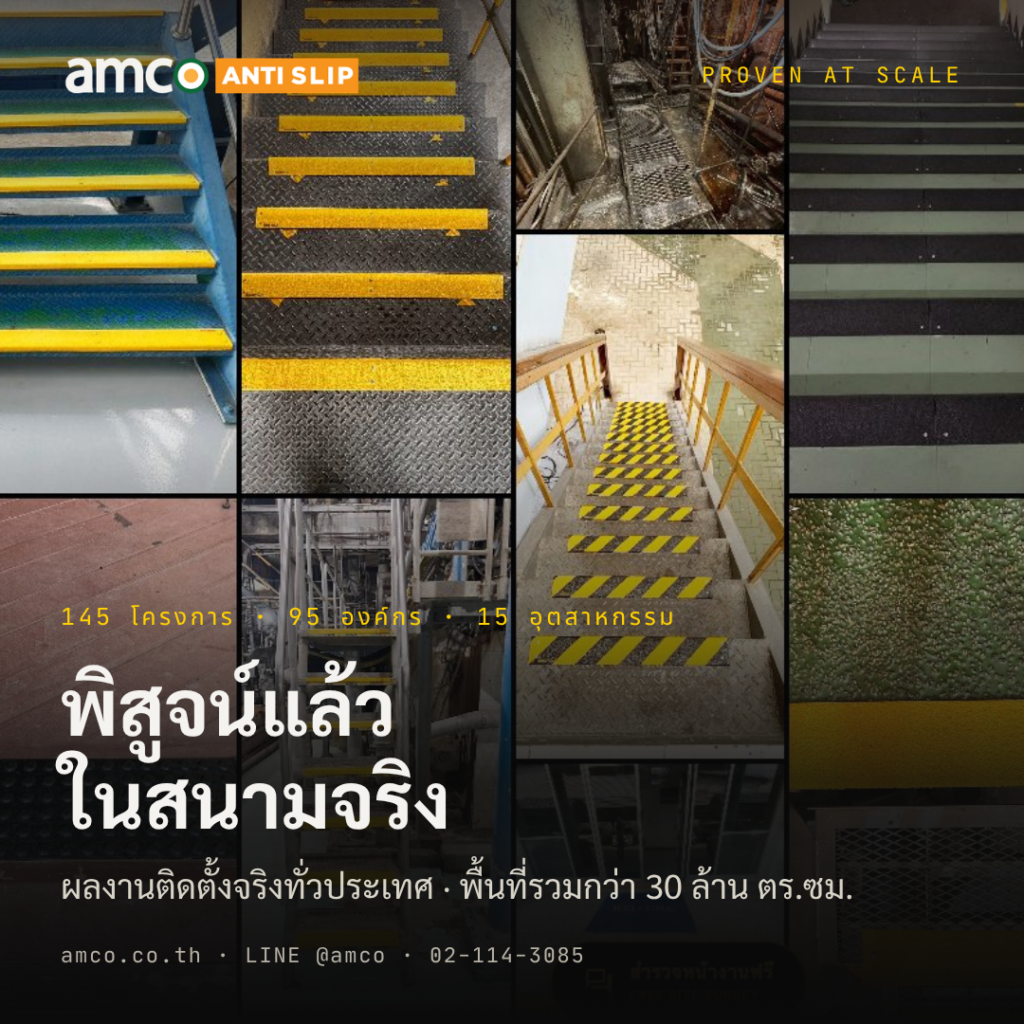
More than 145 installations across 95 organizations and 15 industries are already documented, with 7,390 real install photos — the kind of track record that stands up when an auditor asks “how do you know it works?”
FAQ
Q1: Does anti-slip law in Thailand specifically require anti-slip flooring? The OSH Act B.E. 2554 doesn’t name anti-slip flooring by product. It requires the employer to provide safe working conditions (§6). A slippery floor is an unsafe condition, so addressing it falls under that duty.
Q2: Who is legally responsible if a worker slips and falls — the worker or the employer? The employer carries the duty to provide a safe workplace (§6) and to bear the cost of safety measures (§7). Responsibility for the unsafe condition sits with the employer.
Q3: What is the penalty for breaching workplace safety standards in Thailand? Under §8, failing to meet the ministerial standards can mean imprisonment of up to 1 year, a fine of up to ฿400,000, or both. The Act’s maximum penalty reaches 2 years and ฿800,000 for more serious breaches.
Q4: How common are slip-and-fall deaths at work in Thailand? In 2568 (2025), 123 of 729 workplace deaths — about 1 in 6 — were falls or slips, with 12,855 recorded incidents (Workmen’s Compensation Fund, Social Security Office).
Q5: Is anti-slip tape enough to meet the safety duty? Tape degrades within weeks and must be re-applied repeatedly, so a surface that was “fixed” can become a hazard again. A tested, durable engineered surface with documented performance is easier to defend as meeting the §6 duty.
สำนักงานประกันสังคม — สถิติกองทุนเงินทดแทน (sso.go.th)
พ.ร.บ. ความปลอดภัยฯ พ.ศ. 2554 — ราชกิจจานุเบกษา
3 สาเหตุหลักที่ “เทปกันลื่น” ไม่ใช่คำตอบสำหรับพื้นโรงงาน
Contact block: 📞 02-114-3085 · LINE: @amco ·
🌐 amco.co.th · ✉ info@amco.co.th Free consultation & site survey available.


