
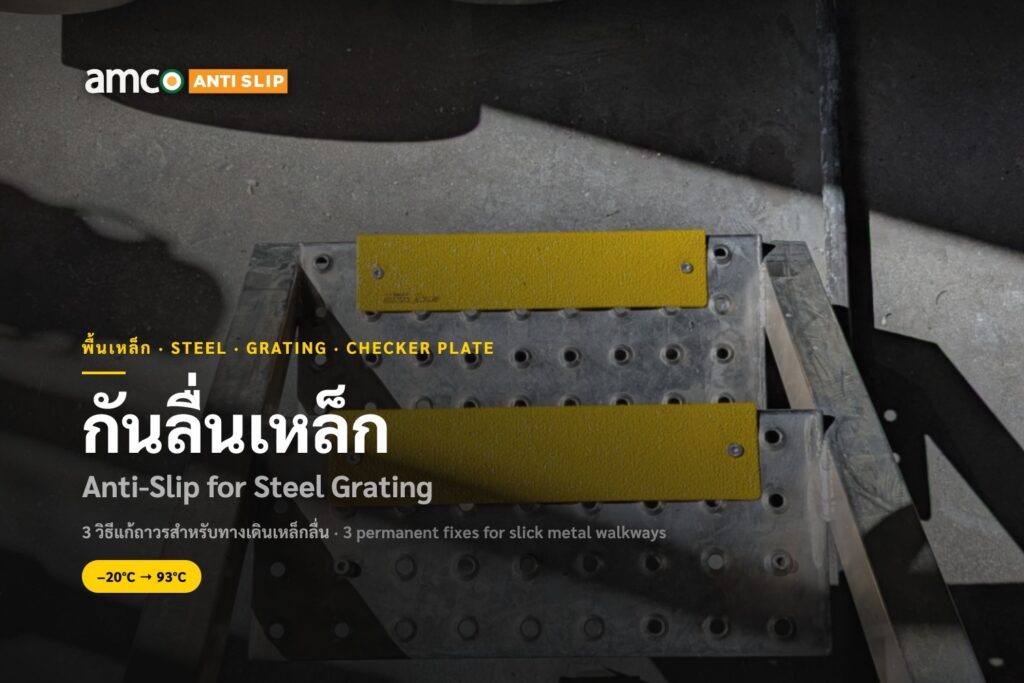
Steel floors, checker plate and open grating are among the most slip-prone surfaces in any plant: metal is smooth, it holds a thin film of oil or condensation, and its raised pattern polishes flat under boots. Anti-slip for steel grating has to be engineered onto the metal, not stuck on top of it — because tape and adhesive strips peel off steel faster than off almost any other substrate. The three permanent fixes are bonded anti-slip plates for solid steel and checker plate, engineered nosing and rung covers for steel stairs and ladders, and custom-cut panels shaped to the grating itself. All three carry a 5+ year service life and a 2-year warranty, tested at PTV 70 dry / 65 wet and R11.
Table of Contents
- Why do steel floors and grating become so slippery?
- Why does tape fail as anti-slip for steel grating?
- Fix 1 — Bonded anti-slip plates for steel floors and checker plate
- Fix 2 — Engineered nosing for steel stairs and ladder rungs
- Fix 3 — Custom-cut anti-slip for steel grating panels
- How is anti-slip for steel grating fixed down?
- Will it survive oil, chemicals and temperature swings?
- Which grade should you specify for a steel walkway?
- FAQ
1. Why do steel floors and grating become so slippery?
Steel is dangerous underfoot for reasons that have nothing to do with housekeeping. Metal is a hard, smooth, non-porous surface, so any liquid that lands on it stays on the surface as a film instead of soaking in — a millimetre of water, oil or condensation is enough to separate a boot sole from the floor. Grating and checker plate are supposed to solve this with a raised pattern, but that pattern is doing the work of a few small contact points, and those points wear first. After a few years of traffic, the diamonds on a checker plate are rounded and shiny, and the grating bars have a mirror-polished top edge.
Then add what a plant actually puts on those surfaces: lubricating oil, hydraulic fluid, coolant, washdown water, process condensate, and — outdoors — rain and dew. The result is a walkway that looks structurally sound and is functionally an ice rink. That combination is why steel walkways, mezzanines and access platforms come up again and again in slip-and-fall investigations, alongside stair nosings.
2. Why does tape fail as anti-slip for steel grating?
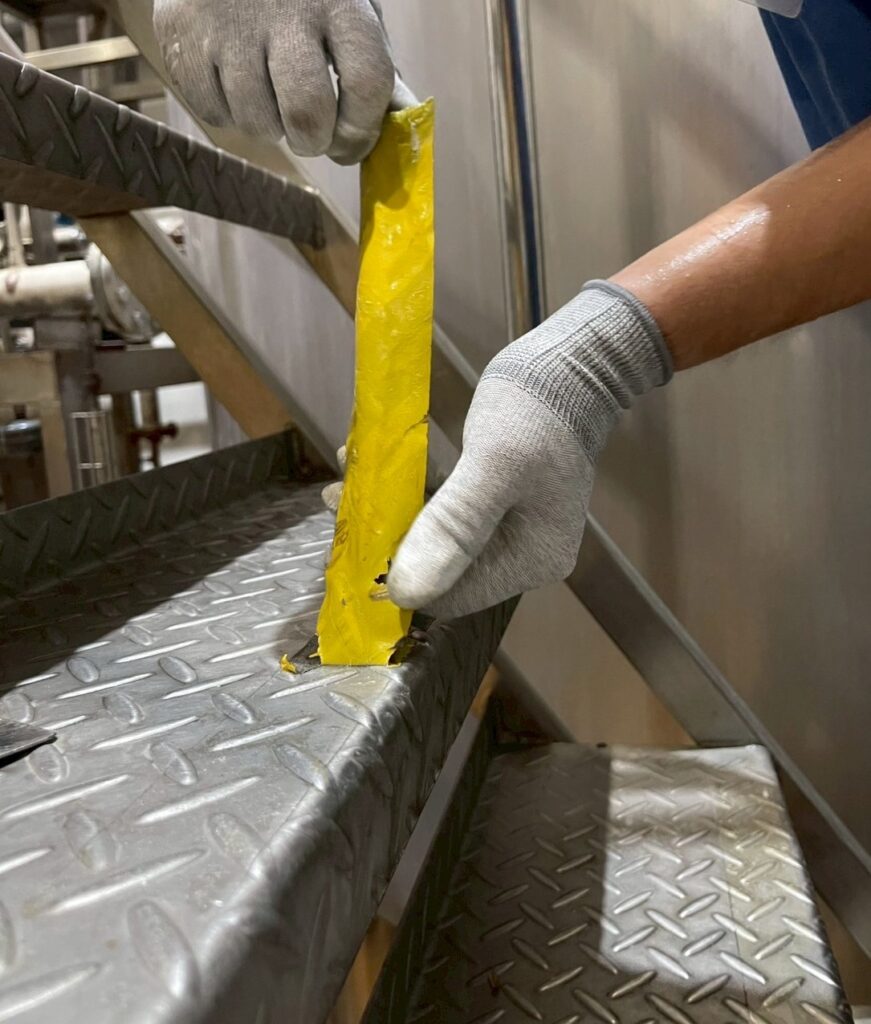
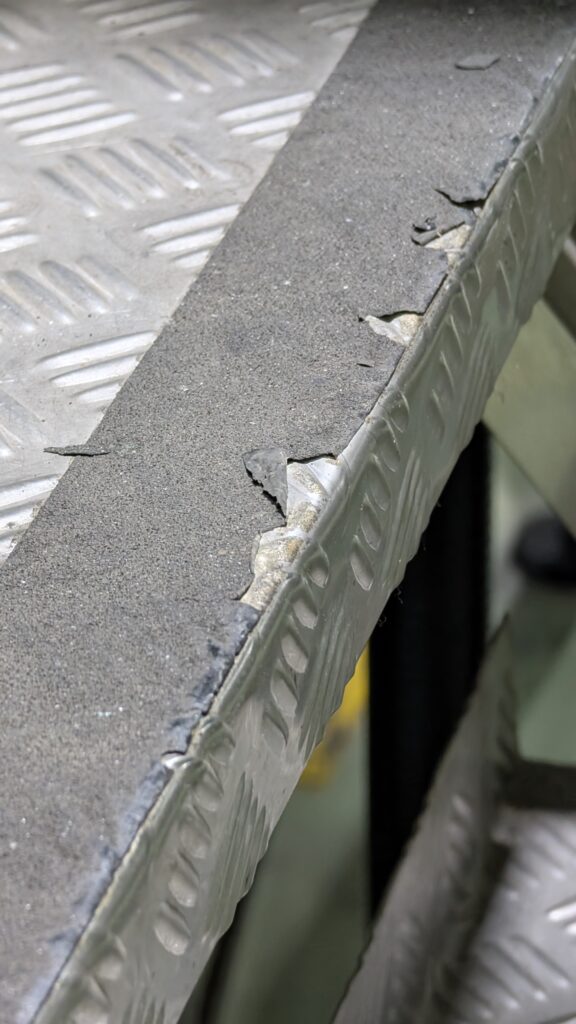
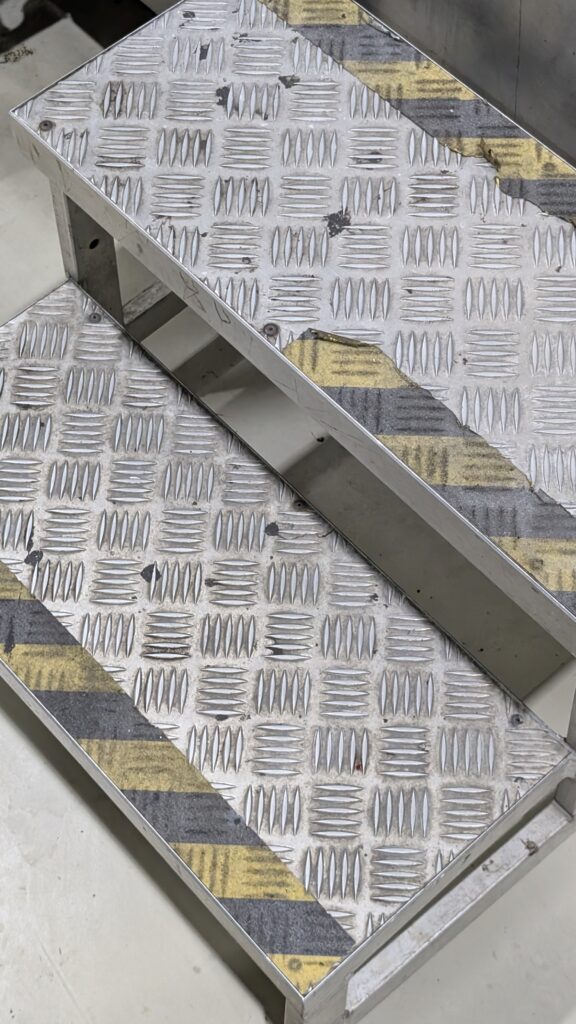
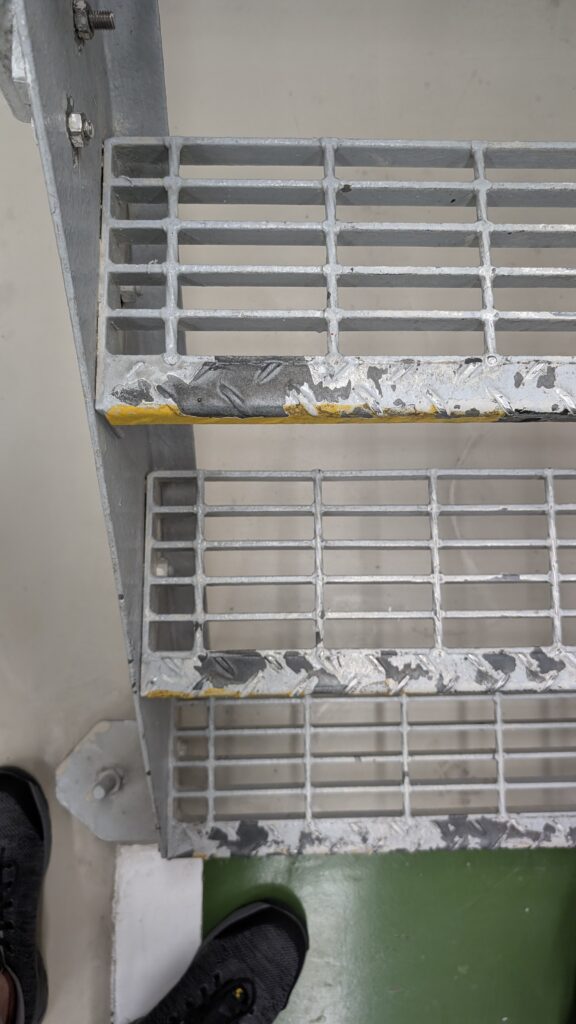
Because adhesive and steel are a bad match, and grating is the worst version of that match. Three things happen:
- Oil undercuts the bond. Adhesive needs a clean, dry, slightly porous surface. Steel is none of those things in a working plant — a residual oil film sits between the glue and the metal from the moment it goes down.
- Grating has almost no surface to stick to. An open grating panel is mostly holes. A strip of tape is bridging voids, bonded only along the narrow top edge of each bar, with nothing supporting it in between. Feet push it into the gaps.
- Thermal movement peels it. Steel expands and contracts far more than the adhesive layer on top of it. Every temperature cycle works the edges loose.
The result is the familiar factory sight: a lifted, curled, grit-worn strip that no longer grips and is now a trip hazard in its own right. A “fix” that fails becomes a new risk — and on a raised steel walkway that risk is a fall from height. This is why proper anti-slip for steel grating is a mechanically-engineered surface, not an adhesive one.
| Bare steel / checker plate | Anti-slip tape | amco engineered plate | |
|---|---|---|---|
| Grip when oily | Very low | Low once grit wears | R11 · PTV 65 wet |
| Grip source | The metal pattern itself | Coating that wears smooth | Silicon carbide bonded in (Mohs ~9.5) |
| Behaviour over time | Polishes flat | Peels, curls, fills with debris | Holds grip |
| Service life | Degrades continuously | ~2 months | 5+ years |
| Re-installs / 5 yrs | — | 30+ | 1 |

3. Fix 1 — Bonded anti-slip plates for steel floors and checker plate
For solid steel floors, checker plate, ramps and platform decking, the fix is an engineered plate laid over the metal and fixed to it. It isn’t a coating and it isn’t a strip: it’s a multi-layer plate with a silicon-carbide grip surface (Mohs ~9.5) — one grade below diamond — fused into the plate rather than sprinkled on top, sitting on a solid metal core. Because the grit is locked inside the surface, it can’t be worn off the way a sprinkled coating polishes smooth.
The practical consequence is that the walkway stops being a maintenance item. It’s tested at pendulum PTV 70 dry / 65 wet against a ≥36 safe minimum, and shod ramp R11 — the working benchmark for wet and oily industrial floors. From 1.7 mm thick at the fine end, it doesn’t turn the platform into a step-up either.
4. Fix 2 — Engineered nosing for steel stairs and ladder rungs
Steel stairs and vertical ladders concentrate the problem. The nose of a steel step and the top of a ladder rung are the smallest contact patches in the building, take the heaviest per-square-centimetre load, and are precisely where a slip converts into a fall down a flight or off a ladder. Steel stair treads made from grating are the worst of both worlds: a narrow bar edge, oiled, at height.
Engineered stair nosing and ladder-rung covers replace that edge with a purpose-shaped grip plate, mechanically fixed. Where the stair is a fire escape or an emergency route, a photoluminescent GLOW grade keeps the step edge visible for up to 6 hours after the lights go out. (For the five checks that separate a lasting nosing from a short-term patch, see our stair nosing guide.)
5. Fix 3 — Custom-cut anti-slip for steel grating panels
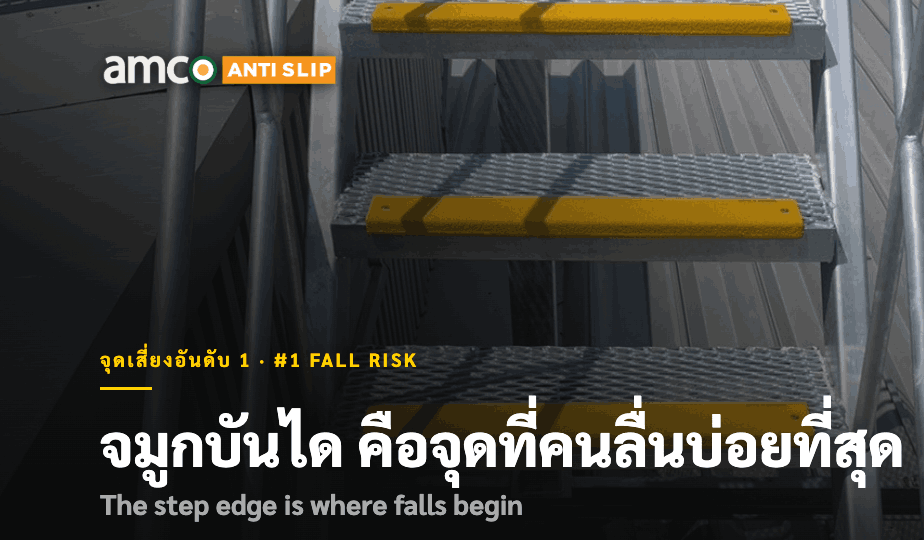
Open grating can’t take a rectangular plate — the fixing points are the bars, and the drainage holes have to stay open. Here the solution is a custom-cut shape: the plate is cut to the panel geometry so it seats on the bars, fixes into them, and leaves the open area free to drain. Walkway sections, landings, access-platform decks and irregular equipment surrounds are all cut to shape rather than trimmed on site.
That matters for two reasons. Drainage is a safety feature — a grating that no longer drains is a puddle waiting to freeze or ice over with oil. And a cut-to-fit plate has no unsupported overhang for a boot to catch, which is exactly the failure mode that field-trimmed strips create.
6. How is anti-slip for steel grating fixed down?
Three installation methods, chosen by substrate and access:
| Method | Use when | Notes |
|---|---|---|
| Screw / bolt fixing | Solid steel, checker plate, structural grating | The default. Mechanical, permanent, no reliance on adhesion |
| Adhesive-only (no drilling) | You can’t drill — coated, pressurised, sealed or listed structures | Flexible PU adhesive bonding, full-surface |
| Combination (adhesive + screws) | High-load, high-vibration, offshore | Belt and braces: bonded and mechanically anchored |
In hygienic areas the perimeter is finished with food-grade sealed edges and food-grade SS304 fixings, so water and residue can’t collect underneath. On offshore and high-vibration steelwork the combination method is standard.
7. Will it survive oil, chemicals and temperature swings?
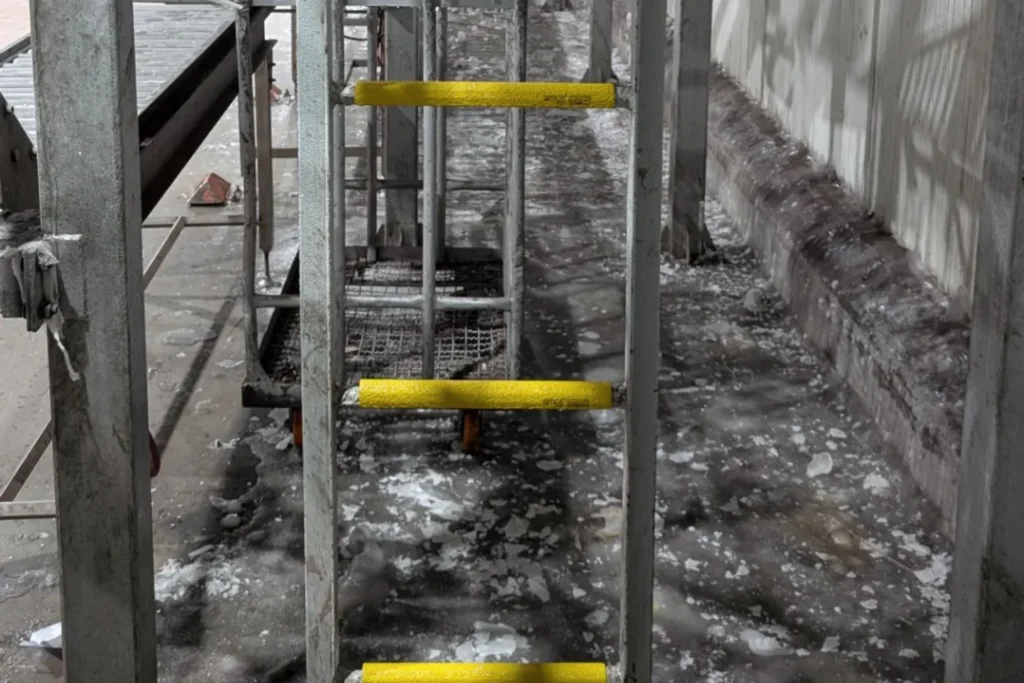
Yes — and this is where the difference from a stuck-on product is starkest. The surface operates from −20 °C to 93 °C, covering freezer floors through to hot washdown, and it shows no visible change after in-house exposure to hydrochloric acid 5%, sodium hydroxide up to 20%, and citric acid 5%. Water, oil and common industrial cleaning chemistry don’t lift it, because there’s no adhesive seam at the surface for them to attack.
That’s the whole argument for engineering anti-slip into steel rather than onto it: the failure mode of every tape and strip is the bond line, and an engineered plate doesn’t have one exposed.
8. Which grade should you specify for a steel walkway?
Match the base material to the corrosion load and the grit grade to the footwear:
- Base material. Zinc-plated steel for general industrial walkways (the most-specified choice). Stainless SS304 for food-grade and washdown areas. Stainless SS316 for offshore, coastal and aggressive-chemical steelwork.
- Grit grade. Steel walkways are safety-boot territory: Coarse (2.5 mm) to Extra Coarse (3.5 mm) for most plants, stepping up to Offshore (5 mm) for the harshest wet and oily conditions, where the coarser grades reach up to R13.
- Marking. Warning stripes, standard safety colours and custom text can be fused into the plate, so hazard marking on a steel edge never peels off.
If you’re unsure, the material selection guide walks the four decisions in order. amco’s engineered anti-slip is installed across 145 projects, 95 organizations and 15 industries, with 7,390 documented install photos — much of it on exactly this kind of steelwork.
FAQ
Q1: Why is steel grating so slippery? Metal is smooth and non-porous, so oil, water and condensation sit on the surface as a film. The raised pattern that provides grip is carried on a few small contact points, and those points polish flat under boot traffic — so an old grating or checker plate loses grip exactly where feet land.
Q2: Can you put anti-slip tape on steel grating? It’s a poor match. Residual oil undercuts the adhesive, an open grating gives the tape almost nothing to bond to, and thermal movement in the steel peels the edges. Tape typically lasts around two months on busy steel and becomes a trip hazard as it curls.
Q3: How is anti-slip for steel grating installed without drilling? With an adhesive-only method using a flexible PU bonding adhesive across the full surface — used where the steelwork can’t be drilled. Where drilling is possible, screw or bolt fixing is the default, and a combination of both is used for high-load or offshore steelwork.
Q4: What slip rating should a steel walkway have? Look for a wet figure, not a dry one. Pendulum PTV 36+ wet is the safe benchmark and R11 is a solid shod-ramp rating for oily industrial steel. amco tests at PTV 70 dry / 65 wet and R11, with coarser grades reaching R13.
Q5: Does anti-slip for steel grating work outdoors and offshore? Yes. Specify stainless SS316 for coastal, marine and offshore steelwork, with the Offshore grit grade (5 mm). The surface operates from −20 °C to 93 °C and resists a wide range of acids and bases.
Q6: Will it stop the grating draining? No — custom-cut panels are shaped to the grating so the open area stays clear. Drainage is a safety function; a plate that blocks it creates standing water.
how to read a slip rating → https://amco.co.th/slip-resistance-rating-explained/
stair nosing guide → https://amco.co.th/anti-slip-stair-nosing/
material selection guide → https://amco.co.th/how-to-choose-anti-slip-material/
Contact block: 📞 02-114-3085 · LINE: @amco ·
🌐 amco.co.th · ✉ info@amco.co.th Free consultation & site survey available.
Latest Posts
- Does Non-Chemical Cooling Tower Treatment Actually Work? An Honest Answer
- Cooling Tower Biofilm: The Hidden Threat Behind Scale, Bugs, and Bills
- Side Stream Filtration for Cooling Towers: 4 Hidden Costs It Cuts (The Honest Guide)
- Slip Hazard Checklist: 7 Factory Zones Every Safety Officer Must Inspect Before an Audit
- Anti-Slip for Steel Grating: 3 Permanent Fixes for Dangerously Slick Metal Walkways
Most Viewed Posts
- Transform Your Slippery Bathroom: 5 DIY Anti-Slip Solutions for Senior Safety.
- What to Do About Slippery Tile Floors? The Ultimate Guide to Solving the Problem, from Simple Fixes to Permanent Solutions
- Sand Filter vs. amco Alfawater: The Filtration Upgrade That Never Stops Your Line
- 3 Critical Reasons ‘Anti-Slip Tape’ Is a Hazard on Factory Floors (And the Ultimate Sustainable Solution).
- 5 Surprising Ways This New Tech “APEF” Uses Physics to Revolutionize Water Treatment
Alfawater amco Alfawater amco ANTI SLIP amco ANTI SLIP amco NOW ANTI BAC Anti Bac Anti Limescale APEF cooling tower DIY Glow Glow Industrial Industrial Water Treatment Sand Filter Scaling Side Stream Filtration กระเบื้อง กันลื่น ความปลอดภัยในบ้าน ฉุกเฉิน ทางหนีไฟ เครื่องกรองน้ำอุตสาหกรรม เรืองแสง โรงงานอุตสาหกรรม


