
Choosing the right anti-slip material isn’t one decision — it’s four, in order: pick the base material (zinc-plated steel, stainless SS304 or SS316, by environment), the grit grade (by footwear and traffic), the thickness (by load), and the safety marking (colour, warning stripes, custom text). Get material and grade right and the surface lasts years in the conditions you actually have; get them wrong and it corrodes, wears, or grips the wrong way for your footwear. This guide walks the four steps with a decision table for each.
Table of Contents
- How do you choose the right anti-slip material?
- Step 1 — Which base material? (zinc-plated, SS304 or SS316)
- Step 2 — Which grit grade? (find your grade by footwear)
- Step 3 — How thick should the anti-slip material be?
- Step 4 — Colour and safety marking on the anti-slip material
- FAQ
1. How do you choose the right anti-slip material?
The right anti-slip material is the one matched to your environment, footwear and load — not just “the grippiest one.” A surface that’s perfect for a dry commercial walkway is wrong for a chemical washdown area, and a grade tuned for safety boots can feel harsh underfoot for barefoot or sandal use. So instead of picking a product off a shelf, work through four decisions in order: base material, grit grade, thickness, and safety marking. Across all four, amco’s grip comes from a silicon-carbide surface (Mohs ~9.5) fused into the plate, so whichever configuration you choose keeps its grip for years rather than polishing smooth.
2. Step 1 — Which base material? (zinc-plated, SS304 or SS316)
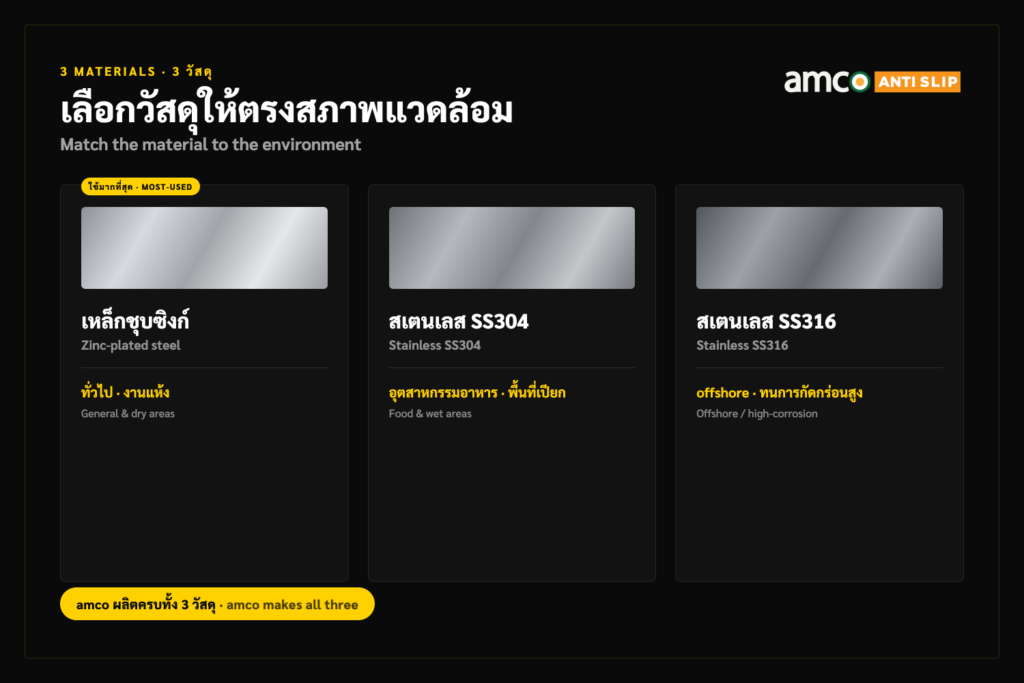
The base material decides corrosion resistance and where the plate can live. Match it to the environment, not the budget line:
| Base material | Best for | Notes |
|---|---|---|
| Zinc-plated steel | General industrial — the most-specified choice | Economical and strong; the default for most industrial floors |
| Stainless SS304 | Food-grade, washdown, general wet and industrial areas | Food-grade, strong corrosion resistance |
| Stainless SS316 | Offshore, coastal/marine, high-corrosion and aggressive-chemical zones | Maximum corrosion resistance |
Zinc-plated steel is the most-specified material and the right default for most general industrial floors. Step up to stainless where the environment demands it: SS304 for food-grade and washdown areas, and SS316 for offshore, coastal/marine, and high-corrosion or aggressive-chemical zones. The common mistake is under-spec’ing — using zinc-plated on a washdown line, or SS304 where the corrosion load really needs SS316.
3. Step 2 — Which grit grade? (find your grade by footwear)
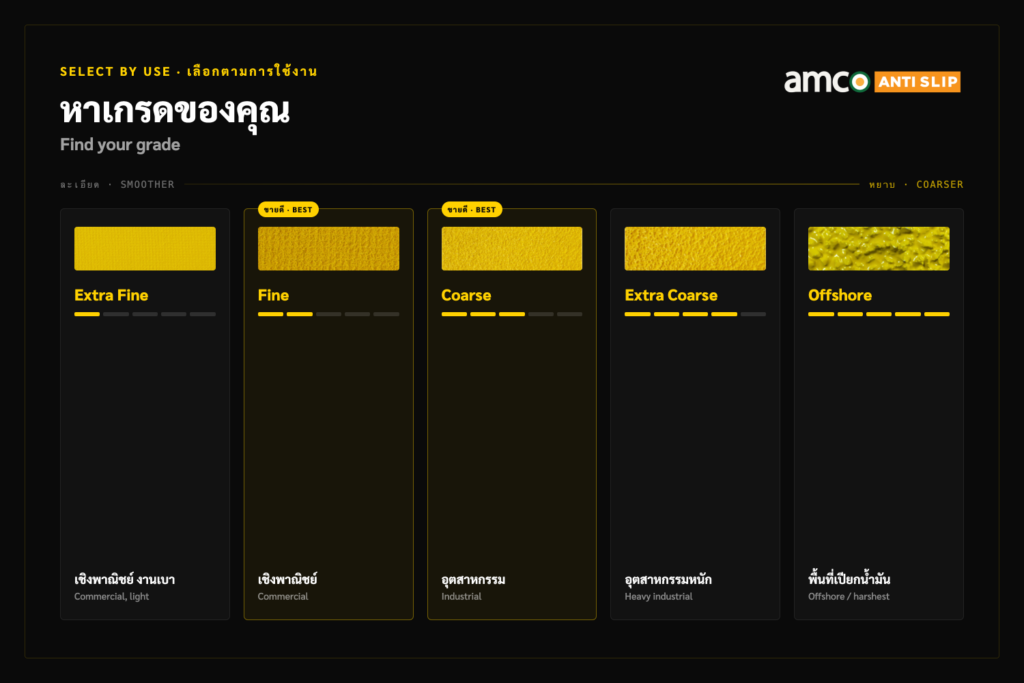
Grip grade should match the footwear people wear and the traffic the area sees. Too fine and it under-grips for safety boots; too coarse and it’s uncomfortable for barefoot or sandals. Find your grade:
| Grade | Footwear | Best for | Approx. thickness |
|---|---|---|---|
| Extra Fine | Barefoot · sandal · sneaker | Commercial, light-duty | 1.7–2.0 mm |
| Fine ★ | Barefoot · sandal · sneaker | Commercial, light-duty (best seller) | 1.7–2.0 mm |
| Coarse ★ | Sneaker · safety shoe | Industrial (best seller) | 2.5 mm |
| Extra Coarse | Sneaker · safety boot | Heavy industrial | 3.5 mm |
| Offshore | Safety boot | Offshore / harshest conditions | 5 mm |
For most factory floors with safety boots, Coarse to Extra Coarse is the sweet spot; barefoot or mixed-footwear areas (locker rooms, light commercial) want Fine or Extra Fine; offshore and the harshest wet/oily environments call for Offshore. The grade also tracks the slip rating — coarser grades reach higher R-values (up to R13).
4. Step 3 — How thick should the anti-slip material be?
Thickness follows from the grade and the load: coarser, heavier-duty grades are thicker, running from 1.7 mm at the fine end up to 5 mm for offshore. The rule of thumb: thick enough to survive the traffic and last, thin enough not to create a trip lip or a ramp people notice. On stairs especially, an over-thick plate becomes an edge to catch — which is why the profile is engineered to grip without adding a hazard of its own. If you’re unsure, the grade you picked in Step 2 already implies the right thickness.
5. Step 4 — Colour and safety marking on the anti-slip material
The last decision is often treated as decoration, but it’s a safety function. Options:
- Standard safety colours — yellow and black, per workplace safety convention.
- Warning stripes — black/yellow diagonal, which doubles as hazard marking on the same plate.
- Custom text and symbols — warnings, directions and symbols fused into the plate, so the signage never peels off like a sticker.
- Custom colours — on request, to match a plant’s colour-coding.
Because the marking is fused into the surface rather than applied on top, it lasts as long as the plate — turning a grip surface into permanent, non-peeling safety signage in one step.
FAQ
Q1: What is the best anti-slip material for a factory? Zinc-plated steel is the most-specified choice for general industrial floors. Step up to stainless SS304 for food-grade and washdown areas, and SS316 for offshore, coastal or high-corrosion environments. Match the material to the conditions first.
Q2: What’s the difference between SS304 and SS316 anti-slip plate? Both are stainless and corrosion-resistant; SS316 has higher resistance to aggressive chemicals and salt/coastal environments, so it’s the step-up choice for harsher conditions. SS304 is food-grade and suits most wet and food areas.
Q3: How do I choose the right grit grade? Match it to footwear and traffic: fine grades for barefoot/sandal and light commercial use, coarse to extra-coarse for industrial safety-boot areas, and offshore grade for the harshest wet/oily conditions.
Q4: How thick should anti-slip material be? Thickness follows the grade — roughly 1.7 mm at the fine end up to 5 mm for offshore. Thick enough to last under the traffic, thin enough not to create a trip edge.
Q5: Can anti-slip material include safety markings? Yes. Standard safety colours, black/yellow warning stripes, and custom text/symbols can be fused into the plate, so the marking never peels and lasts as long as the grip surface.
Stainless Steel Grades Explained: 304, 316, and More
Contact block: 📞 02-114-3085 · LINE: @amco ·
🌐 amco.co.th · ✉ info@amco.co.th Free consultation & site survey available.
Latest Posts
- Does Non-Chemical Cooling Tower Treatment Actually Work? An Honest Answer
- Cooling Tower Biofilm: The Hidden Threat Behind Scale, Bugs, and Bills
- Side Stream Filtration for Cooling Towers: 4 Hidden Costs It Cuts (The Honest Guide)
- Slip Hazard Checklist: 7 Factory Zones Every Safety Officer Must Inspect Before an Audit
- Anti-Slip for Steel Grating: 3 Permanent Fixes for Dangerously Slick Metal Walkways
Most Viewed Posts
- Transform Your Slippery Bathroom: 5 DIY Anti-Slip Solutions for Senior Safety.
- What to Do About Slippery Tile Floors? The Ultimate Guide to Solving the Problem, from Simple Fixes to Permanent Solutions
- Sand Filter vs. amco Alfawater: The Filtration Upgrade That Never Stops Your Line
- 3 Critical Reasons ‘Anti-Slip Tape’ Is a Hazard on Factory Floors (And the Ultimate Sustainable Solution).
- 5 Surprising Ways This New Tech “APEF” Uses Physics to Revolutionize Water Treatment
Alfawater amco Alfawater amco ANTI SLIP amco ANTI SLIP amco NOW ANTI BAC Anti Bac Anti Limescale APEF cooling tower DIY Glow Glow Industrial Industrial Water Treatment Sand Filter Scaling Side Stream Filtration กระเบื้อง กันลื่น ความปลอดภัยในบ้าน ฉุกเฉิน ทางหนีไฟ เครื่องกรองน้ำอุตสาหกรรม เรืองแสง โรงงานอุตสาหกรรม


