

A slip resistance rating is a measured score that tells you how much grip a floor gives — the higher the number, the lower the slip risk. The three you’ll meet most are PTV (a pendulum test; 36 or above = low slip risk), R9–R13 (a shod ramp test for how steep a surface you can walk without slipping), and barefoot classes A/B/C (a barefoot ramp test for wet areas). They come from different tests, so you can’t convert one into another — you read them side by side.
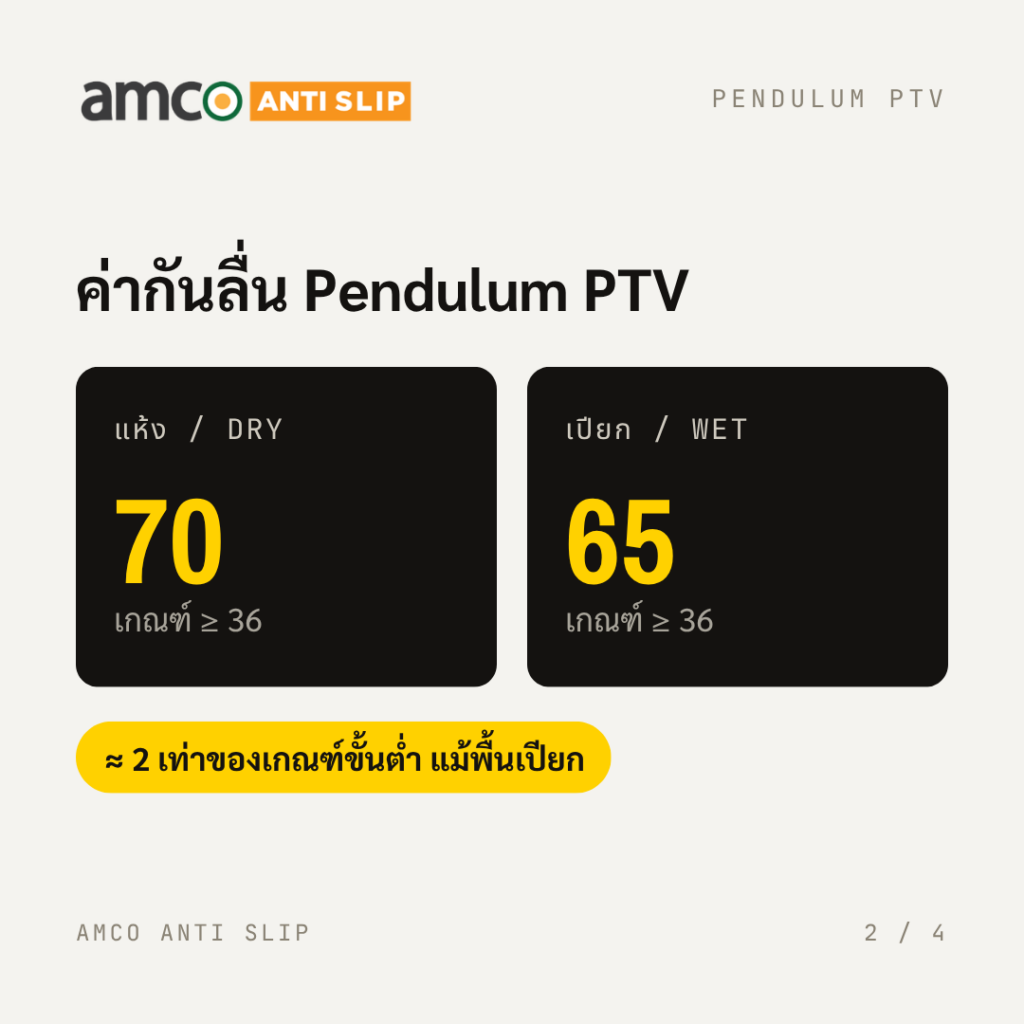
Table of Contents
- What is a slip resistance rating?
- What is PTV (Pendulum Test Value), and what’s safe?
- What do R9–R13 slip ratings mean?
- What is the barefoot A / B / C class?
- Why are there so many standards? (EN 16165)
- How do I read a slip-test report?
- What slip resistance rating does amco achieve?
- FAQ
1. What is a slip resistance rating?
A slip resistance rating is a measured number that describes how much friction a floor surface provides underfoot — in other words, how likely someone is to slip on it. Instead of guessing whether a floor “feels grippy,” a rating gives you an objective figure from a standardised test, so you can compare surfaces and prove a floor meets a safe threshold.
The catch is that there isn’t one universal number. Different labs use different tests — a swinging pendulum, an inclined ramp with a person in boots, an inclined ramp with a person barefoot — and each produces its own kind of score. Below are the three systems you’ll actually see on a datasheet, what each measures, and the number that counts as safe.
2. What is PTV (Pendulum Test Value), and what’s safe?
The Pendulum Test Value (PTV) is the most widely used slip resistance rating for real floors, measured with a pendulum whose rubber slider drags across the surface — dry and wet — to simulate a heel strike. The higher the PTV, the more grip. The standard method is BS 7976-2, and it’s the test UK safety bodies rely on because it works both in the lab and on site.
The safety thresholds are well established:
| PTV | Slip potential |
|---|---|
| 0–24 | High slip potential |
| 25–35 | Moderate slip potential |
| 36 and above | Low slip potential (the safe target) |
So on a PTV report, 36 is the line — a surface tested at 36 or higher (ideally in the wet condition, which is the harder test) is considered low-risk. Anything below 25 is a red flag.
3. What do R9–R13 slip ratings mean?
The R-value is a shod (shoe-on) slip resistance rating from a ramp test: a person in safety footwear walks up an oil-wetted ramp that tilts steeper and steeper until they slip. The steeper the angle they can handle, the higher the R-rating. The method is DIN 51130, and it’s the rating most quoted for industrial and workshop floors.
| R-value | Ramp angle (approx.) | Typical use |
|---|---|---|
| R9 | 6°–10° | Dry indoor areas, entrances |
| R10 | 10°–19° | General wet areas, some workshops |
| R11 | 19°–27° | Industrial wet/oily floors, kitchens |
| R12 | 27°–35° | Heavy industrial, food processing |
| R13 | above 35° | The most demanding wet/oily environments |
For most factory wet or oily areas, R11 is the practical benchmark for good grip, with R12–R13 reserved for the harshest conditions.
4. What is the barefoot A / B / C class?
Where people walk barefoot on wet floors — changing rooms, showers, pool surrounds — the shod R-value doesn’t apply. Instead there’s a separate barefoot slip resistance rating from a water-wetted ramp test (DIN 51097), graded A, B or C:
| Class | Ramp angle (approx.) | Typical use |
|---|---|---|
| A | ≥ 12° | Barefoot dry-transition areas, changing rooms |
| B | ≥ 18° | Shower floors, pool surrounds |
| C | ≥ 24° | Pool ramps, steps into water — the highest barefoot grip |
Class C is the top barefoot grade — the most slip-resistant of the three.
5. Why are there so many standards? (EN 16165)
Because each test answers a different question: PTV measures a heel-strike on any floor, the R-value measures shod grip on a slope, and A/B/C measures barefoot grip on a slope. They’re complementary, not competing. Since 2021, several of these ramp methods have been consolidated under the European standard EN 16165, with the R and A/B/C classifications carried over — so you may see a datasheet cite EN 16165 alongside, or instead of, the older DIN numbers. The important point for a buyer: a single surface can carry more than one rating, and each one tells you about a different scenario. Never treat an R-value as if it converts to a PTV number — they’re separate measurements from separate tests.
6. How do I read a slip-test report?
A few practical checks when a supplier hands you a slip resistance rating:
- Look for the wet result, not just the dry one. Dry grip is easy; wet is where slips happen. A credible report shows both.
- Check the method. BS 7976-2 for pendulum PTV; DIN 51130 (or EN 16165) for the shod R-value; DIN 51097 for barefoot A/B/C. The method tells you what the number actually means.
- Match the rating to your zone. Oily workshop floor → R-value. Poolside → A/B/C. A stair or walkway you want a defensible on-site figure for → PTV.
- Ask who tested it. An independent lab report carries more weight in an audit than an unsourced marketing claim.
7. What slip resistance rating does amco achieve?

AMCO’s engineered anti-slip is tested across all three systems, with results comfortably above the safe thresholds:
- Pendulum PTV: 70 dry / 65 wet — against a ≥36 safe minimum, that’s roughly double the threshold, and it holds up in the wet test (method BS 7976-2).
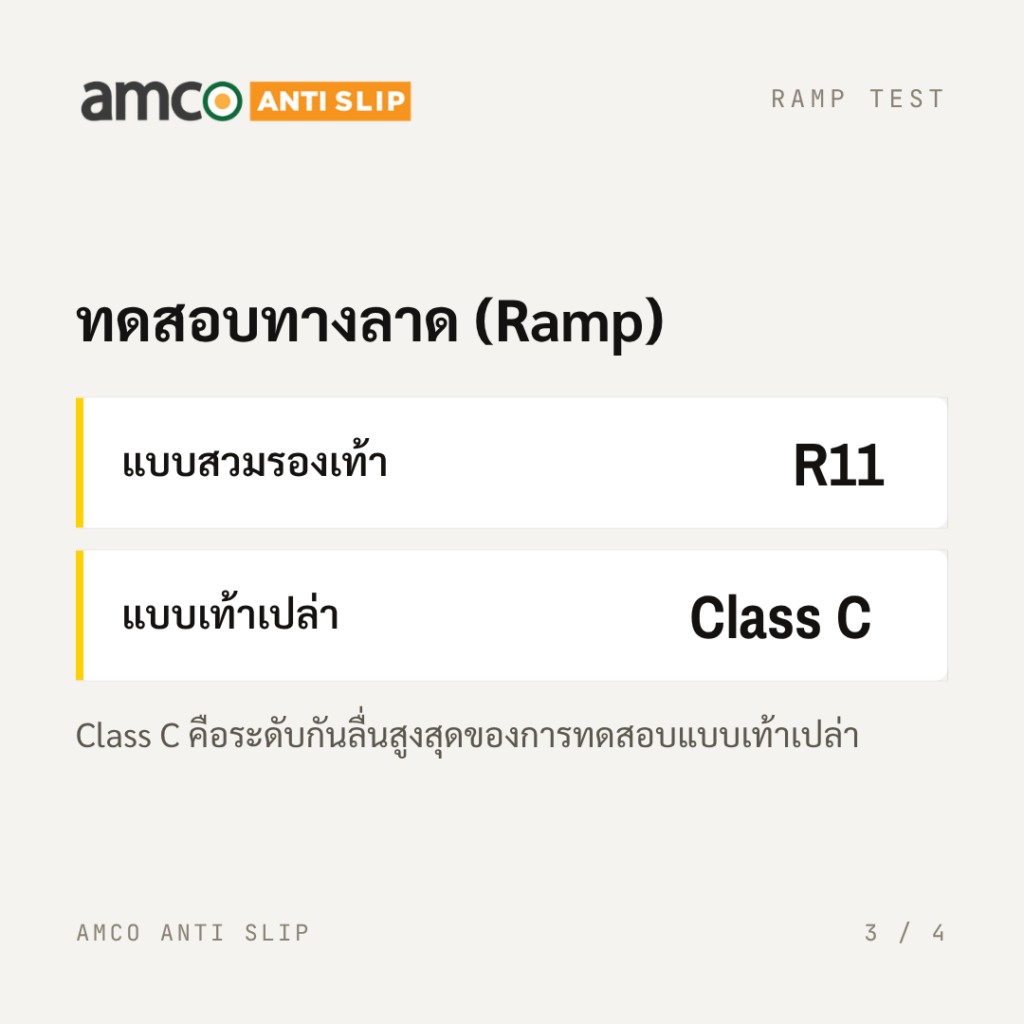
- Shod ramp: R11 (up to R13 in the coarser and offshore grades) — strong grip for industrial wet and oily floors.
- Barefoot ramp: Class C — the highest barefoot grade, for wet barefoot areas.
Because the grip comes from a silicon-carbide surface (Mohs ~9.5) bonded into the plate rather than a coating that wears smooth, these ratings hold through heavy traffic — backed by a documented 5+ year service life and a 2-year warranty. That’s the difference between a number on day one and a number that still holds after five years of boots.
FAQ
Q1: What slip resistance rating is considered safe? For pendulum PTV, 36 or above indicates low slip potential and is the usual safe target — ideally measured in the wet condition. For shod ramp testing, R11 is a common benchmark for industrial wet areas.
Q2: What’s the difference between PTV and R-value? PTV comes from a pendulum test that simulates a heel strike on any floor (BS 7976-2). The R-value comes from a ramp test with a person in safety footwear on an oiled slope (DIN 51130). They measure different things and don’t convert into each other.
Q3: Is R11 good enough for a factory floor? For most wet or oily industrial areas, R11 is a solid benchmark. The harshest environments (heavy oil, food processing) may call for R12 or R13.
Q4: What does barefoot Class C mean? Class C is the highest of the barefoot slip-resistance grades (A/B/C) from the DIN 51097 water-wetted ramp test, suited to the wettest barefoot areas like pool ramps.
Q5: Can one surface have more than one slip rating? Yes. A surface can carry a PTV, an R-value, and a barefoot class at once, because each comes from a separate test for a separate scenario. amco, for example, is rated PTV 70/65, R11, and Class C.
3 สาเหตุหลักที่ “เทปกันลื่น” ไม่ใช่คำตอบสำหรับพื้นโรงงาน
Contact block: 📞 02-114-3085 · LINE: @amco ·
🌐 amco.co.th · ✉ info@amco.co.th Free consultation & site survey available.


