
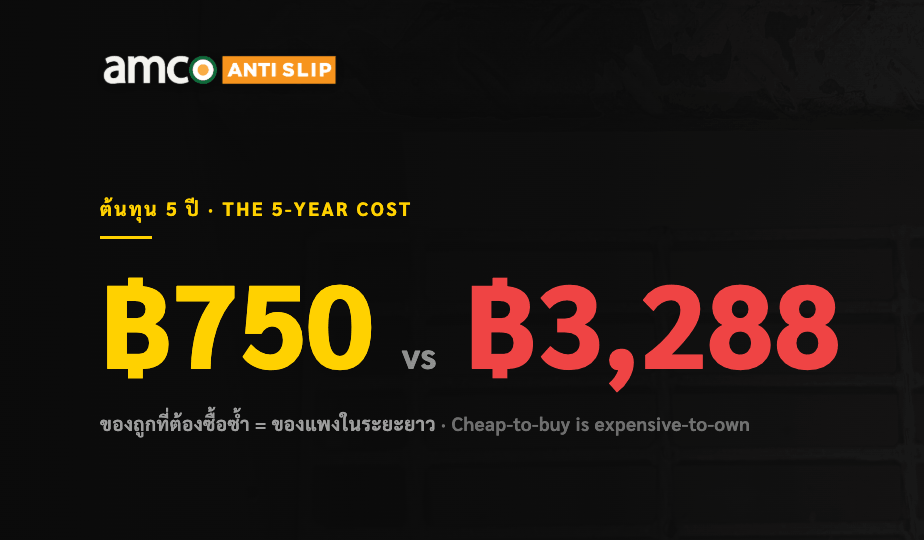
The real anti-slip cost is not the sticker price on install day — it’s what you pay over the life of the floor. Anti-slip tape looks cheaper up front but lasts about two months, so over five years it’s re-applied 30+ times. Costed properly per stair step over five years, engineered anti-slip runs about ฿750 against ฿1,716–฿3,288 for tape — roughly 4.4× cheaper than the pricier tape — while saving 96% of install time and 55% of material cost. Cheap-to-buy becomes expensive-to-own.
Table of Contents
- What is the real anti-slip cost — price or total cost?
- The 5-year anti-slip cost: engineered vs tape
- Why does cheap anti-slip tape cost more over time?
- The hidden costs: labour, downtime and the gaps between
- How much do you actually save?
- When is engineered anti-slip worth the higher upfront price?
- FAQ
1. What is the real anti-slip cost — price or total cost?
The mistake most budgets make is comparing anti-slip solutions on purchase price instead of total cost of ownership. Anti-slip tape wins on day-one price and loses badly over time, because it doesn’t last — a roll bought today is a roll re-bought, re-cut and re-applied a few months from now, again and again. Engineered anti-slip costs more to install once and then essentially stops costing you. To compare them fairly, you have to look at the same unit — one stair step — over the same period — five years.
2. The 5-year anti-slip cost: engineered vs tape
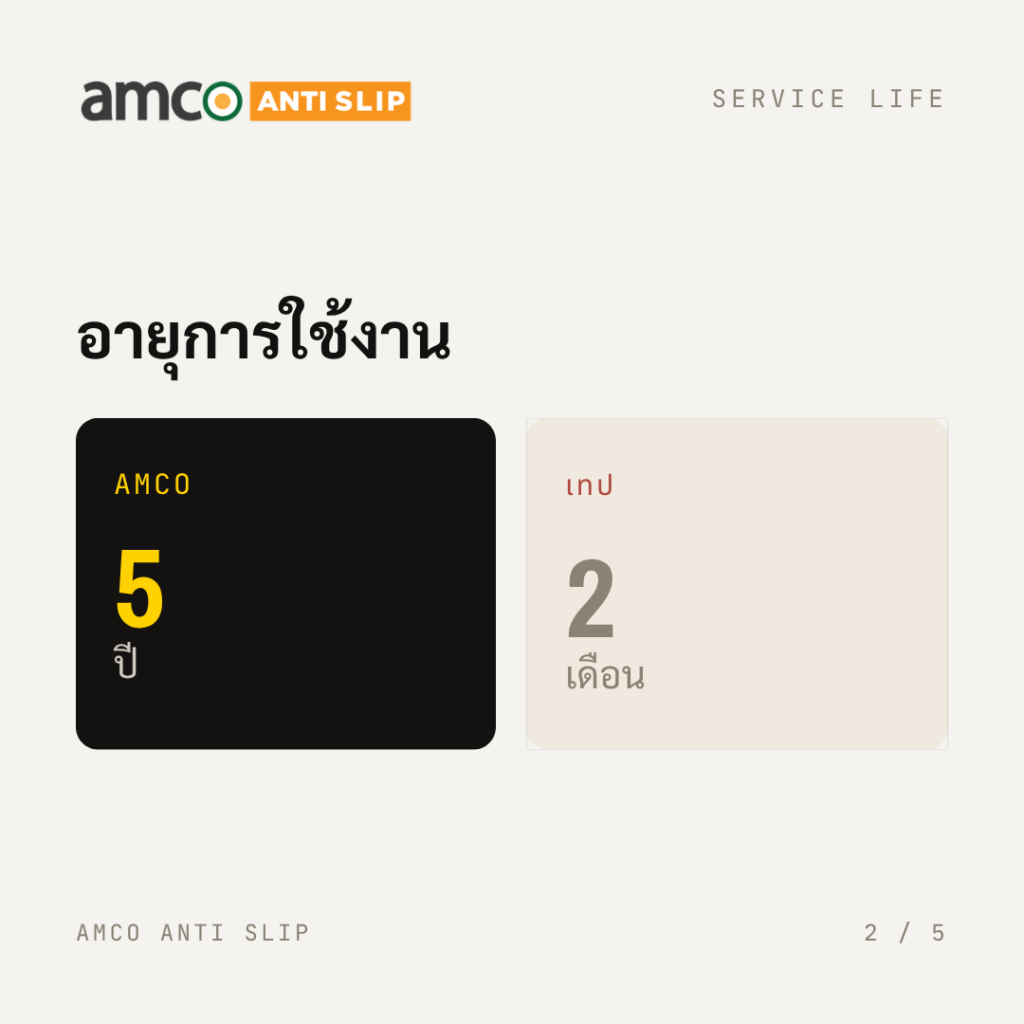
Here is that comparison, costed per stair step over a five-year horizon:
| amco engineered | Anti-slip tape (A) | Anti-slip tape (B) | |
|---|---|---|---|
| 5-year cost / step | ฿750 | ฿3,288 | ฿1,716 |
| Service life | 5+ years | ~2 months | ~2 months |
| Re-installs in 5 years | 1 | 30+ | 30+ |
| Day-one price | Higher | Low | Low |
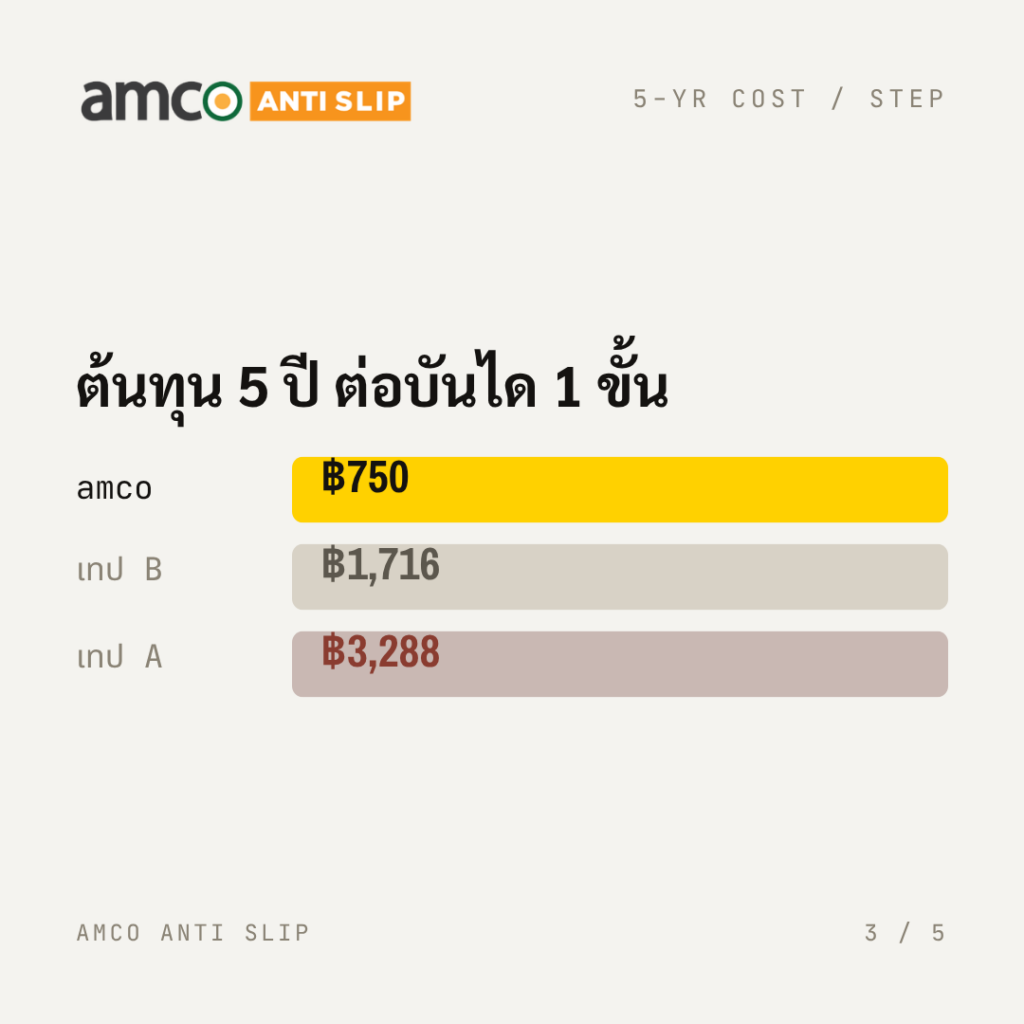
Against the pricier tape, engineered anti-slip is roughly 4.4× cheaper over five years — despite costing more on the first day. The single install carries a 5+ year service life with a 2-year warranty; the tape is bought and fitted more than thirty times to cover the same period.
3. Why does cheap anti-slip tape cost more over time?
Because you don’t buy it once — you buy it repeatedly. Anti-slip tape on a busy stair or walkway degrades in roughly two months: the grit wears smooth, the edges peel, and it stops gripping. Each replacement is a fresh purchase of material, plus the labour to strip the old tape and lay the new. Multiply that by 30+ cycles across five years and the “cheap” option quietly becomes the expensive one — and that’s before counting the cost of the downtime each re-application needs.
4. The hidden costs: labour, downtime and the gaps between
The sticker price hides three real costs that only show up over time:
- Labour, 30+ times over. Every re-application is scheduled work — surface prep, removal, fitting. Engineered anti-slip is one install.
- Downtime. Stairs, walkways and platforms often have to be closed while tape is stripped and re-laid. Repeat that dozens of times and the lost access adds up.
- The dangerous gaps. Between the day tape starts failing and the day it’s replaced, you have a worn, peeling surface that no longer protects anyone — a live slip hazard sitting in your workplace. Engineered anti-slip holds its grip continuously, so there’s no recurring window of risk.
That last point is where cost and safety meet: a cheaper product that lapses into a hazard isn’t a saving, it’s a liability.
5. How much do you actually save?
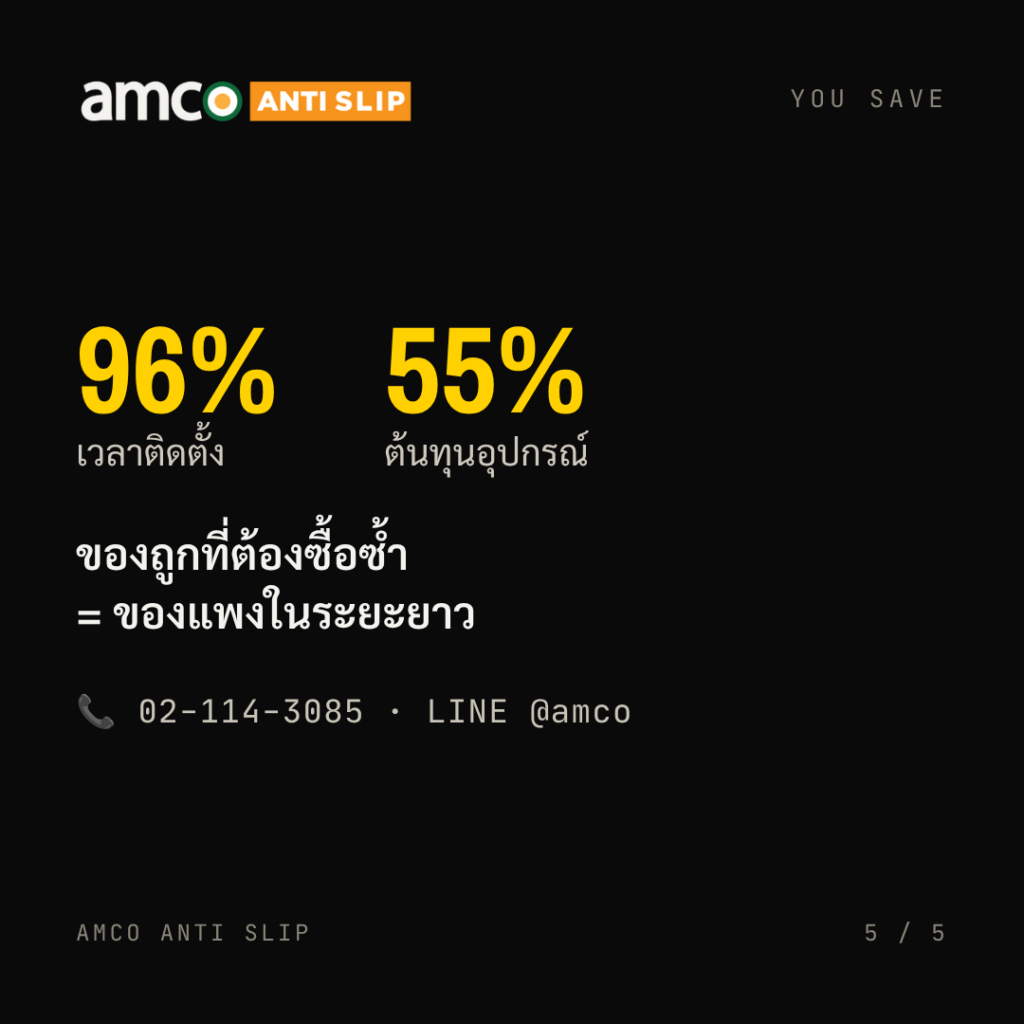
Switching from repeated tape to a single engineered install saves, per the same-step comparison, about 96% of install time and 55% of material cost across five years — on top of removing the downtime and the recurring hazard windows. The saving isn’t a discount on day one; it’s the sum of all the re-installs, labour hours and closures you no longer pay for.
6. When is engineered anti-slip worth the higher upfront price?
Almost anywhere the surface sees real traffic and stays in use for years — which is most industrial stairs, walkways, ramps and platforms. The higher upfront anti-slip cost is worth it when: the area is high-traffic (tape fails fastest there), the surface is wet, oily or washed down (tape peels fastest there), closing it repeatedly is disruptive, or the location is safety-critical and can’t afford to lapse into a hazard between re-applications. For a one-off, low-traffic, short-life spot, tape may be fine — but for the stairs and walkways people use every day, the five-year math favours doing it once. amco’s engineered anti-slip is installed across 145 projects in 15 industries on exactly those surfaces.
FAQ
Q1: Is anti-slip tape really cheaper than engineered anti-slip? Only on day one. Tape lasts about two months, so over five years it’s re-applied 30+ times. Costed per stair step over five years, engineered anti-slip is about ฿750 vs ฿1,716–3,288 for tape.
Q2: How much does anti-slip flooring cost over 5 years? On a per-step basis over five years, amco engineered anti-slip works out to roughly ฿750, compared with ฿1,716–3,288 for anti-slip tape that must be replaced repeatedly.
Q3: How much can you save vs anti-slip tape? Around 96% of install time and 55% of material cost over five years, plus the downtime and recurring hazard windows you avoid by installing once.
Q4: Why is engineered anti-slip more expensive upfront? Because it’s a durable multi-layer plate mechanically fixed to the surface, built for a 5+ year service life (2-year warranty), rather than a thin adhesive layer. The higher first cost is recovered many times over by not re-buying and re-fitting it.
Q5: When is anti-slip tape good enough? For a low-traffic, short-life, one-off spot, tape can be acceptable. For high-traffic, wet or safety-critical stairs and walkways used daily, the 5-year cost strongly favours an engineered solution.
สถิติกองทุนเงินทดแทน (การลื่นล้ม/ตก)
3 Critical Reasons ‘Anti-Slip Tape’ Is a Hazard on Factory Floors (And the Ultimate Sustainable Solution).
Contact block: 📞 02-114-3085 · LINE: @amco ·
🌐 amco.co.th · ✉ info@amco.co.th Free consultation & site survey available.
Latest Posts
- Does Non-Chemical Cooling Tower Treatment Actually Work? An Honest Answer
- Cooling Tower Biofilm: The Hidden Threat Behind Scale, Bugs, and Bills
- Side Stream Filtration for Cooling Towers: 4 Hidden Costs It Cuts (The Honest Guide)
- Slip Hazard Checklist: 7 Factory Zones Every Safety Officer Must Inspect Before an Audit
- Anti-Slip for Steel Grating: 3 Permanent Fixes for Dangerously Slick Metal Walkways
Most Viewed Posts
- Transform Your Slippery Bathroom: 5 DIY Anti-Slip Solutions for Senior Safety.
- What to Do About Slippery Tile Floors? The Ultimate Guide to Solving the Problem, from Simple Fixes to Permanent Solutions
- 3 Critical Reasons ‘Anti-Slip Tape’ Is a Hazard on Factory Floors (And the Ultimate Sustainable Solution).
- 5 Surprising Ways This New Tech “APEF” Uses Physics to Revolutionize Water Treatment
- Sand Filter vs. Alfawater: Which Water Filtration Technology Can Truly Cut Industrial Costs?
Alfawater amco Alfawater amco ANTI SLIP amco ANTI SLIP amco NOW ANTI BAC Anti Bac Anti Limescale APEF cooling tower DIY Glow Glow Industrial Industrial Water Treatment Sand Filter Scaling Side Stream Filtration กระเบื้อง กันลื่น ความปลอดภัยในบ้าน ฉุกเฉิน ทางหนีไฟ เครื่องกรองน้ำอุตสาหกรรม เรืองแสง โรงงานอุตสาหกรรม


