
Ask a vendor for the ROI on a water-treatment upgrade and you’ll usually get one confident number pinned to someone else’s cooling tower. We don’t work that way — because the honest answer depends on your water, your scale, and your tariffs, and a brochure average is worse than useless when you’re signing off capex. This guide shows the four places side stream filtration pays you back, how big each lever realistically is, and how to size the number for your own tower.
Table of contents
- The four return levers (not one)
- Energy: a recovery, not a permanent curve
- Water and chemicals: the steady savings
- Maintenance and uptime: the uncounted return
- How to size your ROI honestly
- Frequently asked questions
1. The four return levers (not one)
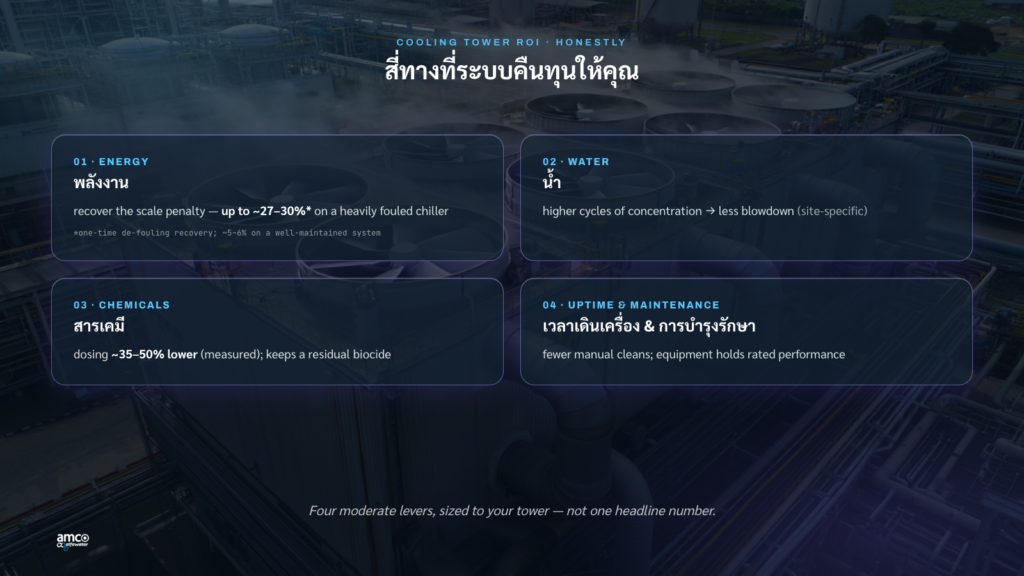
Scale on a heat-exchange surface costs you in four ways at once, so removing it pays back in four ways at once:
- Energy — scale is an insulator; a fouled chiller burns more power for the same cooling.
- Water — cleaner chemistry lets you run higher cycles of concentration, cutting blowdown.
- Chemicals — a cleaner system needs less antiscalant and biocide dosing.
- Maintenance & uptime — fewer manual cleans, less downtime, longer equipment life.
The mistake most ROI pitches make is quoting one big headline number. The honest picture is four moderate levers whose sum is worth measuring — and whose size depends entirely on how fouled you are to begin with.
2. Energy: a recovery, not a permanent curve
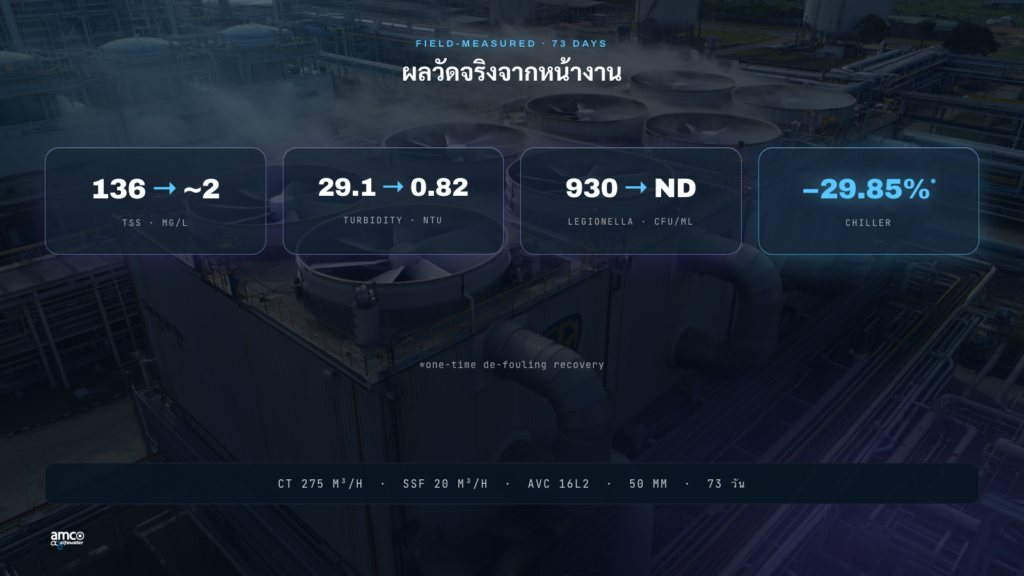
This is the lever most often oversold. Here’s the honest version: removing scale lets a fouled chiller recover efficiency it had lost. In one field trial, chiller efficiency improved up to ~27–30% — but that is a one-time de-fouling recovery, a heavily fouled system being cleaned back toward its design point, not a number you keep improving on every month. On a well-maintained plant the recoverable penalty is far smaller — independent utility studies put it around 5–6%. The dirtier your system today, the more there is to get back; the cleaner it is, the less. Anyone quoting you a flat, permanent “30% energy saving” is quoting the recovery as if it were a monthly annuity. It isn’t.
3. Water and chemicals: the steady savings
These are the levers that keep paying month after month:
- Water. Holding scale in check with filtration instead of aggressive blowdown lets you push cycles of concentration toward the next real limit in your water — cutting make-up and discharge. The size is site-specific, so we size it conservatively rather than promising a headline.
- Chemicals. A cleaner loop needs less dosing. In the field trial, chemical dosing fell ~35–50% (measured). Note the honest ceiling: an open tower always keeps a residual biocide — this is a large reduction, never “chemical-free.”
4. Maintenance and uptime: the uncounted return
The return that rarely makes it into a spreadsheet is often the one operators value most: fewer manual descaling shutdowns, cleaner heat exchangers holding their rated performance longer, and less risk of a scale- or biofilm-driven problem forcing an unplanned stop. It’s harder to put a single figure on, which is exactly why we’d rather measure it on your system than guess.
5. How to size your ROI honestly
Because all four levers scale with your specific conditions, the only defensible ROI is a measured one. Our free assessment does exactly that: we measure your water (TSS, turbidity, chemistry), gauge how much scale and habitat is actually in your loop, and model the four levers against your real tariffs and run hours. You get a number sized to your tower — and if it doesn’t justify the investment, we’ll tell you so. That’s the whole reason we measure instead of promise.
6. Frequently asked questions
What’s the payback period?
It depends on how fouled your system is, your energy and water tariffs, and your run hours — so we won’t quote a fixed month figure that came off another site. We model it on your measured data.
How much energy will I save?
Up to ~27–30% is possible as a one-time de-fouling recovery on a heavily fouled chiller; a well-maintained system recovers far less (~5–6%). Your figure depends on how much scale you’re carrying now.
Will it eliminate my chemical costs?
No. It reduces dosing (~35–50% measured); an open tower always keeps a residual biocide.
How do I get a number for my tower?
Book a free assessment — we measure and model it, no obligation.
Call to action
Book a free cooling-tower assessment. We’ll measure your water and model your energy, water, chemical, and maintenance returns — sized to your tower, not a brochure average.
👉 amco.co.th/cooling-tower-assessment
📞 02-114-3085 · LINE: @amco · ✉ info@amco.co.th


