

Most cooling-tower problems get blamed on scale. But underneath the scale — literally — is something that drives all three of your biggest headaches at once: biofilm. It’s the slippery microbial layer that shelters bacteria, anchors scale, and quietly raises your energy and chemical bills. This guide explains what cooling tower biofilm is, the three silent threats it creates, and the honest way to deal with it — habitat removal, not a miracle claim.
Table of contents
- What is cooling tower biofilm?
- The three silent threats
- Why chemicals alone don’t finish the job
- The honest fix: remove the habitat
- What to measure on your tower
- Frequently asked questions
1. What is cooling tower biofilm?
Biofilm is a thin, sticky community of microorganisms that colonises wetted surfaces — tower fill, basins, and heat-exchanger tubes. It matters because a cooling tower constantly concentrates nutrients and warmth: every time water evaporates to reject heat, what’s left behind gets richer. Left alone, biofilm becomes both a shelter for bacteria and a foundation that helps scale bond to metal. Remove it, and several problems ease at once.
2. The three silent threats

Biofilm sits underneath your three most expensive cooling-tower problems:
- Bacteria (including Legionella). Biofilm is where waterborne bacteria shelter. It’s the reason a chemicals-only programme can look fine one week and see a Legionella rebound the next — the population is protected inside the film. (We cover this in detail in Legionella in cooling towers.)
- Scale. Biofilm gives scale a foothold, and scale on a heat-exchange surface is an insulator — a fouled chiller burns more energy for the same cooling.
- Chemical cost. The harder your biofilm and scale problem, the heavier the antiscalant and biocide dosing you lean on to keep it in check.
One root layer, three bills.
3. Why chemicals alone don’t finish the job
An open cooling tower needs a residual biocide, and it helps. But biocide is dosed into the water, while biofilm’s strength is that it shelters organisms inside the film, where dosed chemical penetrates poorly. You can knock back what’s floating free and still leave the anchored community to rebuild. That’s not a failure of chemistry — it’s a limit of treating the water without removing the habitat.
4. The honest fix: remove the habitat
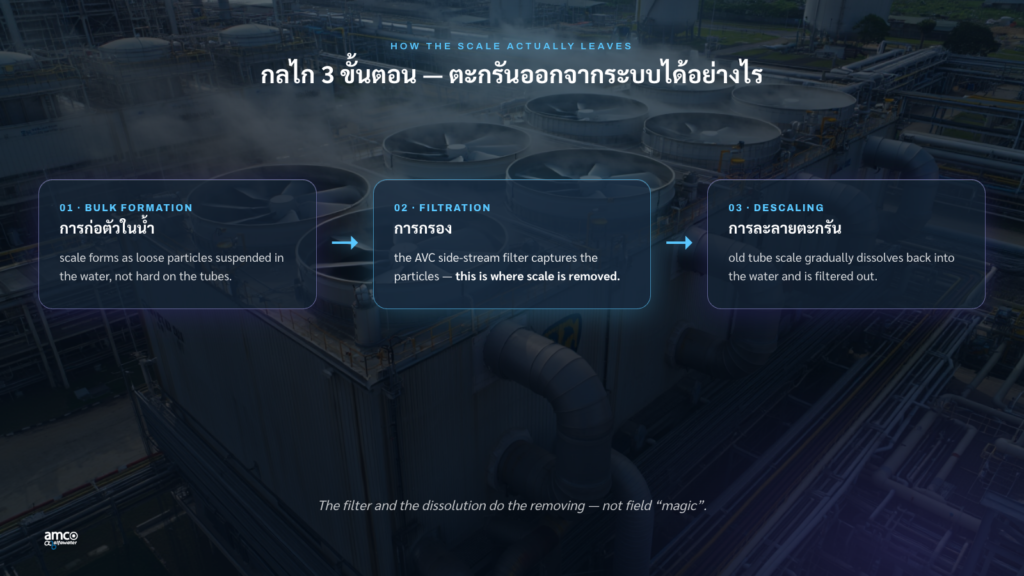
The durable approach is to take the habitat out of the loop rather than promise to zap it. An Aragon APEF field plus an AVC self-cleaning side-stream filter works in three honest steps:
- Loose formation. The field encourages scale to form as loose particles suspended in the water instead of hardening onto surfaces — laying down less new foundation for biofilm.
- Filtration. The side-stream filter continuously captures those particles — this is where the material, and the organisms riding it, are actually removed.
- Descaling. As the water carries less scale, older scale and its biofilm gradually dissolve back into the water and are filtered out too.
A residual biocide stays in the programme — now working on a much cleaner system. This is a large reduction in habitat, scale, and dosing, not “zero scale” or “chemical-free.” The full mechanism and field proof are in our pillar guide, side stream filtration for cooling towers.
5. What to measure on your tower
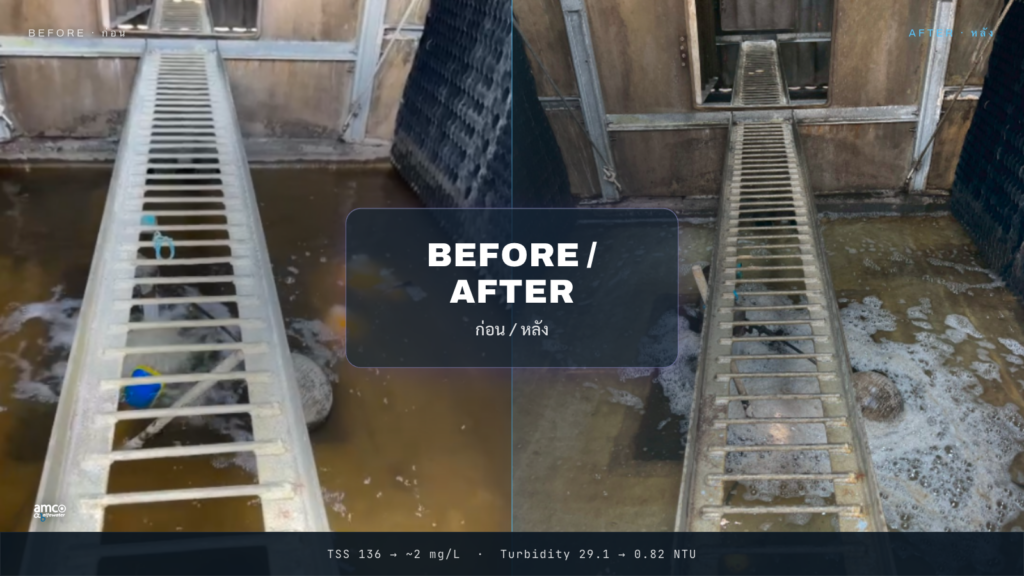
You can’t manage what you don’t measure. The honest signals of a biofilm/scale problem are simple: suspended solids (TSS) and turbidity in the water, Legionella culture, and how often you’re manually cleaning basins and exchangers. In one field trial, filtration took TSS 136 → ~1–5 mg/L and turbidity 29 → 0.8 NTU — visible proof the habitat load was actually leaving the system.
6. Frequently asked questions
What causes biofilm in a cooling tower?
Warm, nutrient-rich recirculating water on wetted surfaces. Evaporation concentrates nutrients, and microorganisms colonise fill, basins, and tubes.
Is biofilm the same as scale?
No — biofilm is microbial and sticky; scale is mineral. But they reinforce each other: biofilm helps scale bond, and scale shelters biofilm.
Can you remove biofilm without chemicals?
Not entirely — an open tower keeps a residual biocide. But removing the scale/biofilm habitat by filtration lets you dose far less (~35–50% measured), and the biocide then works on a cleaner system.
Does removing biofilm help with Legionella?
Yes — it removes the shelter. In a field trial, Legionella fell from 930 CFU/mL to non-detect via habitat removal, filtration, and a residual biocide.
Call to action
Book a free cooling-tower assessment. We’ll measure your water and your habitat load — sized to your tower, not a brochure average.
👉 amco.co.th/cooling-tower-assessment
📞 02-114-3085 · LINE: @amco · ✉ info@amco.co.th
Latest Posts
- Does Non-Chemical Cooling Tower Treatment Actually Work? An Honest Answer
- Cooling Tower Biofilm: The Hidden Threat Behind Scale, Bugs, and Bills
- Side Stream Filtration for Cooling Towers: 4 Hidden Costs It Cuts (The Honest Guide)
- Slip Hazard Checklist: 7 Factory Zones Every Safety Officer Must Inspect Before an Audit
- Anti-Slip for Steel Grating: 3 Permanent Fixes for Dangerously Slick Metal Walkways
Most Viewed Posts
- Transform Your Slippery Bathroom: 5 DIY Anti-Slip Solutions for Senior Safety.
- What to Do About Slippery Tile Floors? The Ultimate Guide to Solving the Problem, from Simple Fixes to Permanent Solutions
- Sand Filter vs. amco Alfawater: The Filtration Upgrade That Never Stops Your Line
- 3 Critical Reasons ‘Anti-Slip Tape’ Is a Hazard on Factory Floors (And the Ultimate Sustainable Solution).
- 5 Surprising Ways This New Tech “APEF” Uses Physics to Revolutionize Water Treatment
Alfawater amco Alfawater amco ANTI SLIP amco ANTI SLIP amco NOW ANTI BAC Anti Bac Anti Limescale APEF cooling tower DIY Glow Glow Industrial Industrial Water Treatment Sand Filter Scaling Side Stream Filtration กระเบื้อง กันลื่น ความปลอดภัยในบ้าน ฉุกเฉิน ทางหนีไฟ เครื่องกรองน้ำอุตสาหกรรม เรืองแสง โรงงานอุตสาหกรรม


