
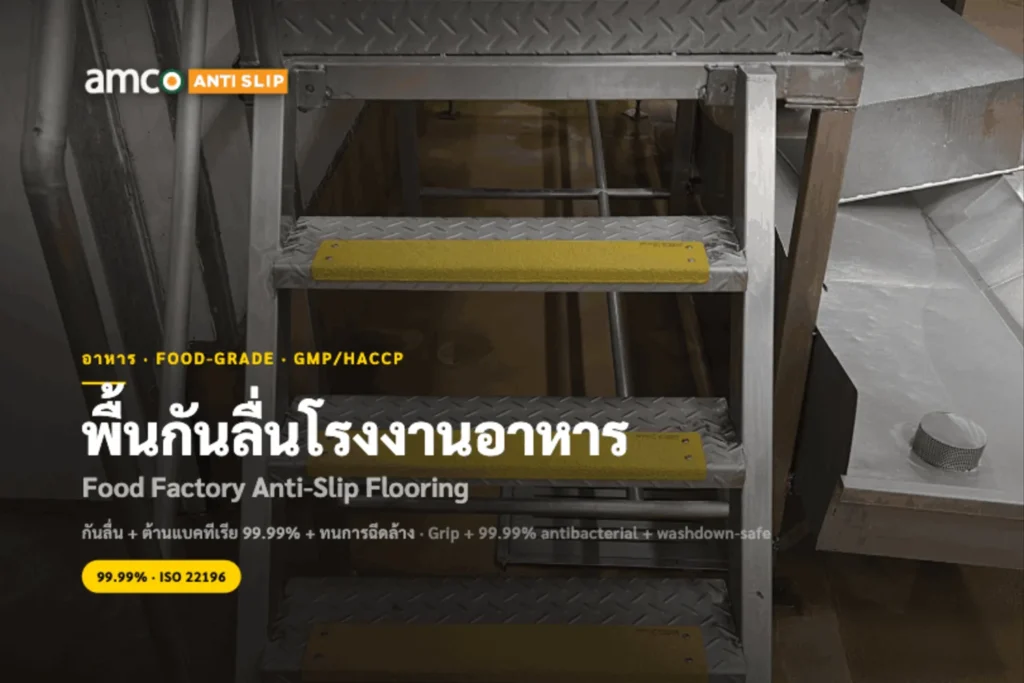
In a food plant, food factory anti-slip flooring has a double job: stop slips and pass a hygiene audit. A wet, washed-down production floor is one of the most slip-prone environments there is, but grip alone isn’t enough — the surface also has to be antibacterial, sealed against water and debris, made of food-grade materials, and able to survive daily pressure-washing and chemicals. The six requirements below are what separate a compliant food-plant floor from a liability. amco’s system meets all six: R11 / PTV 70-65 grip, 99.99% antibacterial (ISO 22196), food-grade SS304 fixings, sealed edges, washdown-safe, and chemical/temperature resistant.
Table of Contents
- What does food factory anti-slip flooring actually need to do?
- The 6 requirements for GMP/HACCP wet areas
- Why is slip resistance harder in a food plant?
- Why antibacterial matters for a hygiene audit
- Where food factory anti-slip flooring is used
- FAQ
1. What does food factory anti-slip flooring actually need to do?
Ordinary anti-slip flooring only has to grip. Food factory anti-slip flooring has to grip and satisfy food-safety standards like GMP and HACCP at the same time — because the same wet, oily, frequently-washed surfaces that cause slips are also the surfaces that harbour bacteria if they’re not designed correctly. A strip of grip tape might stop a slip on day one, but it peels, traps water and food debris under its edges, and fails a hygiene inspection. So in a food environment the question isn’t just “does it grip?” — it’s “does it grip, stay clean, and survive washdown for years?”
2. The 6 requirements for GMP/HACCP wet areas

Here’s what a food-plant floor surface has to deliver, and how amco’s system meets each:
- 1. Real, wet slip resistance. Food floors are wet and oily, so grip must be proven in the wet, not just dry. Look for pendulum PTV 36+ wet and shod ramp R11. amco tests at PTV 70 dry / 65 wet and R11, with Class C barefoot.
- 2. Antibacterial surface. The surface should actively reduce bacteria, not just be wipeable. amco⁺ reduces surface bacteria by 99.99%, tested to ISO 22196 against E. coli and S. aureus — the antibacterial agent is built into the surface, not a coating on top, so it doesn’t wear away.
- 3. Food-grade materials. Fixings and plate should be food-safe and corrosion-resistant. amco uses food-grade stainless SS304 fixings and SS304/316 plate.
- 4. Sealed edges. Open edges trap water, food particles and bacteria. amco’s edges are food-grade sealed, leaving no gap for contamination to collect and no crevice that corrodes fixings.
- 5. Washdown and pressure-wash safe. Food areas are cleaned hard and often. The surface must withstand high-pressure washing and cleaning chemistry without lifting or degrading — amco is built for it.
- 6. Chemical and temperature resistance. From freezer floors to hot washdown, and from acids to caustics, the surface must hold up. amco resists a wide range of acids and bases and works from −20°C to 93°C.
Meet all six and the floor is both safe underfoot and defensible in an audit. Miss one — usually the sealing or the antibacterial part — and a “grippy” floor becomes a hygiene finding.
3. Why is slip resistance harder in a food plant?
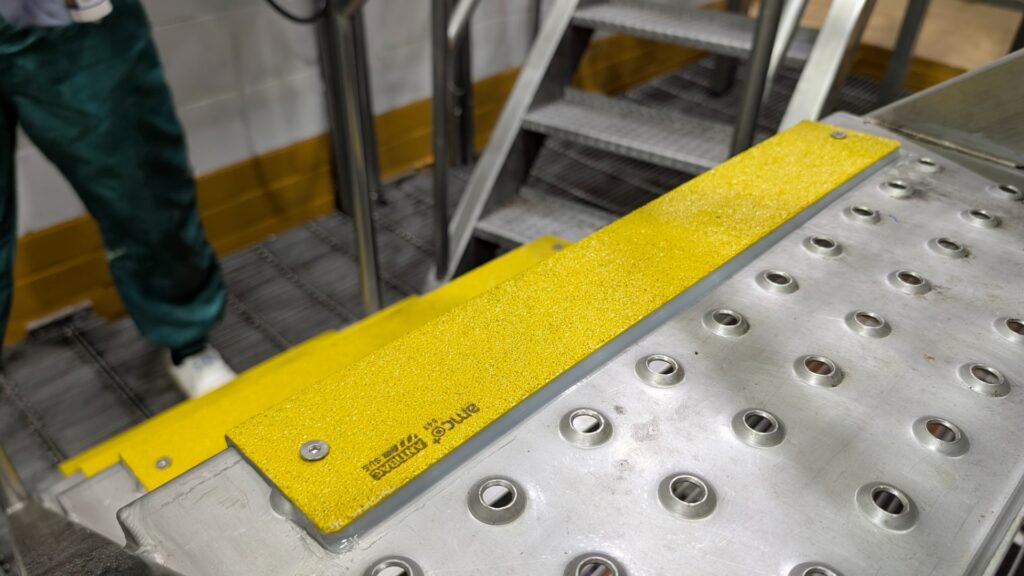
Because the contamination is constant and aggressive. General industrial floors deal with occasional water or oil; food floors deal with grease, fat, brine, sugar syrups, blood, and cleaning foam — every shift, followed by a high-pressure washdown. These contaminants slash the slip resistance of a smooth or worn surface, which is exactly why the wet PTV and R-rating matter so much here, and why a surface that only grips when dry is dangerous in a food plant. A silicon-carbide grip surface (Mohs ~9.5) that keeps its texture through years of washing is what holds the grip when the floor is covered in fat and foam.
4. Why antibacterial matters for a hygiene audit
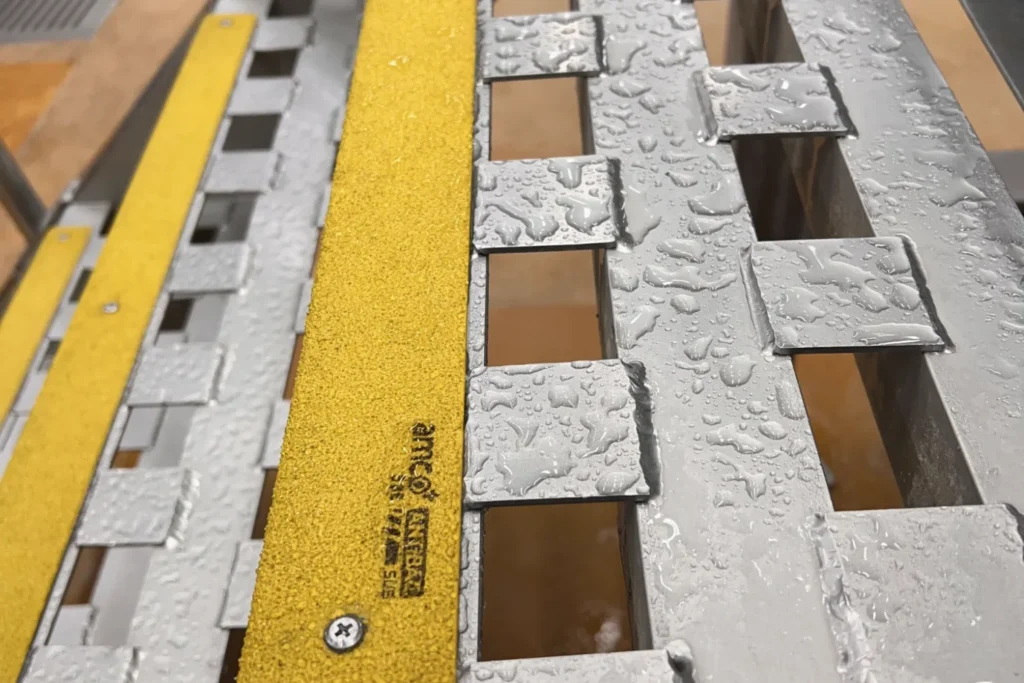
In a HACCP or GMP environment, the floor isn’t just a walking surface — it’s part of the hygienic zone. Standing water and organic residue in floor cracks and under peeling tape are exactly what auditors look for. A surface that reduces bacteria by 99.99% (ISO 22196), has no open edges to trap residue, and can be pressure-washed clean removes that finding at the source. It turns the floor from a potential audit failure into evidence that the hygienic design was done properly — which is the same logic a safety officer uses for slip compliance.
5. Where food factory anti-slip flooring is used
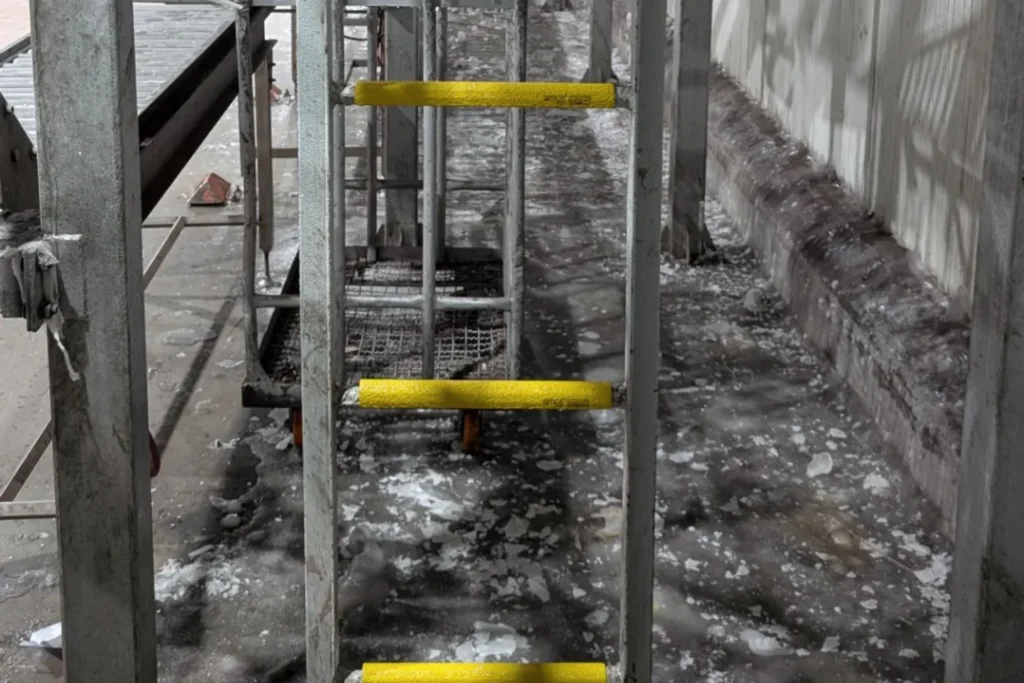
The high-value zones in a food or beverage plant: washdown production areas (constant water + cleaning), freezer and cold-store floors (−20°C, condensation), wet process stairs and mezzanines (the fall risk plus hygiene), loading and packing areas, and pharma clean areas with the same requirements. Food and beverage is amco’s largest sector — the system is installed across dozens of food-plant projects, on exactly these surfaces.
FAQ
Q1: What makes flooring suitable for a food factory? It must grip when wet, be antibacterial, use food-grade materials, have sealed edges, survive pressure-washing, and resist chemicals and temperature swings — meeting GMP/HACCP hygiene requirements as well as slip safety.
Q2: Does anti-slip flooring need to be antibacterial in a food plant? For hygienic zones, yes — the surface should actively reduce bacteria. amco⁺ reduces surface bacteria by 99.99% (ISO 22196), with the antibacterial agent built into the surface rather than coated on top.
Q3: Can food factory anti-slip flooring be pressure-washed? Yes. amco is washdown and high-pressure-wash safe, with food-grade sealed edges so water and debris can’t collect under the plate.
Q4: What slip rating is needed for a wet food floor? Look for wet performance: pendulum PTV 36+ wet and shod ramp R11 are solid benchmarks. amco tests at PTV 70/65 and R11.
Q5: Does it work in freezers and cold stores? Yes. amco operates from −20°C to 93°C and resists a wide range of chemicals, so it suits freezer floors through to hot washdown areas.
ISO 22196 (antibacterial test standard) →
anti-slip stair nosing for wet stairs
3 Critical Reasons ‘Anti-Slip Tape’ Is a Hazard on Factory Floors (And the Ultimate Sustainable Solution).
Contact block: 📞 02-114-3085 · LINE: @amco ·
🌐 amco.co.th · ✉ info@amco.co.th Free consultation & site survey available.
Latest Posts
- Does Non-Chemical Cooling Tower Treatment Actually Work? An Honest Answer
- Cooling Tower Biofilm: The Hidden Threat Behind Scale, Bugs, and Bills
- Side Stream Filtration for Cooling Towers: 4 Hidden Costs It Cuts (The Honest Guide)
- Slip Hazard Checklist: 7 Factory Zones Every Safety Officer Must Inspect Before an Audit
- Anti-Slip for Steel Grating: 3 Permanent Fixes for Dangerously Slick Metal Walkways
Most Viewed Posts
- Transform Your Slippery Bathroom: 5 DIY Anti-Slip Solutions for Senior Safety.
- What to Do About Slippery Tile Floors? The Ultimate Guide to Solving the Problem, from Simple Fixes to Permanent Solutions
- Sand Filter vs. amco Alfawater: The Filtration Upgrade That Never Stops Your Line
- 3 Critical Reasons ‘Anti-Slip Tape’ Is a Hazard on Factory Floors (And the Ultimate Sustainable Solution).
- 5 Surprising Ways This New Tech “APEF” Uses Physics to Revolutionize Water Treatment
Alfawater amco Alfawater amco ANTI SLIP amco ANTI SLIP amco NOW ANTI BAC Anti Bac Anti Limescale APEF cooling tower DIY Glow Glow Industrial Industrial Water Treatment Sand Filter Scaling Side Stream Filtration กระเบื้อง กันลื่น ความปลอดภัยในบ้าน ฉุกเฉิน ทางหนีไฟ เครื่องกรองน้ำอุตสาหกรรม เรืองแสง โรงงานอุตสาหกรรม


